Insights
Best Anti-Fatigue Mat for Concrete Floors (UK Workplaces)
Concrete is the hardest, coldest floor most people stand on at work. Which anti-fatigue mats cope with it, how thick to go, and what to check about the slab before you buy.
- anti-fatigue
- concrete floors
- warehouse
- factory
- buying guide
The Short Answer
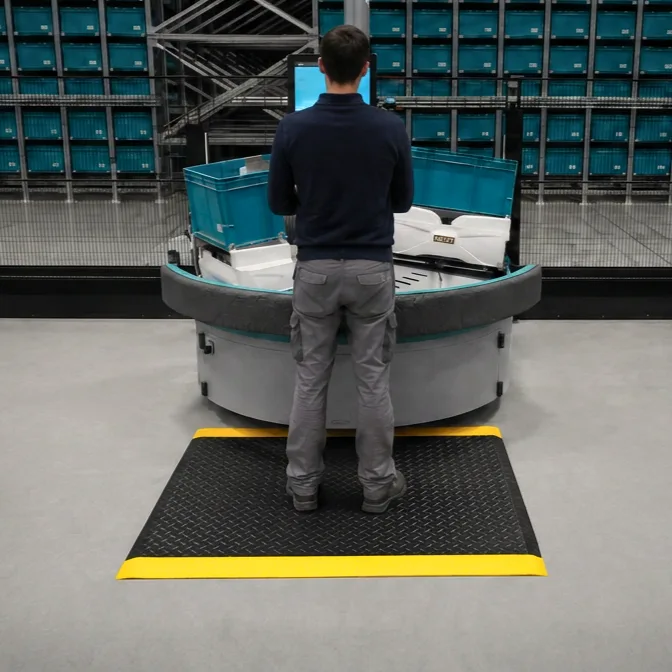
For a dry concrete floor where people stand all shift, a 13 mm or thicker high-density foam mat with bevelled edges is the best value. For concrete that gets oil, coolant or water on it, use interlocking tiles, with drainage holes if fluid lands on the floor regularly. For concrete in a cold store or near an open dock door, use a mat rated for the temperature, or a heated mat.
The rest of this article explains why.
Why Concrete Is the Worst Floor to Stand On
Concrete has almost no give. Every bit of your weight goes straight back up through your heels, and because the surface does not move, nor do you. That is the combination that makes standing tiring: static muscles and pressure that never shifts.
It is also cold. A concrete slab in an unheated warehouse sits at roughly the temperature of the ground and pulls heat out of feet through the soles of boots. Staff at fixed workstations notice this long before the air feels cold.
A mat on concrete needs to deal with both problems: cushioning for the hardness, and insulation for the cold.
What to Look For
Enough thickness to actually help
Thin mats feel fine in a shop and flatten on concrete within weeks, because there is nothing under them to share the load. As a rule:
- 9 to 10 mm for part-shift standing on a dry slab, such as goods-in desks and inspection points.
- 13 mm for full 8-hour shifts.
- 20 to 25 mm tiles for heavy industrial work, or where you need drainage underneath.
Bevelled edges
On a hard floor, a square-edged mat is a trip hazard and catches trolley wheels. Look for edges that slope down to the floor on every side people walk across.
An underside that grips
Concrete is often dusty. A mat with a smooth back will creep across a dusty slab over a shift. Check the underside has a texture or grip pattern, and sweep the floor before you lay it.
The right material for what lands on it
This is the one people get wrong. Foam comfort mats are excellent on dry concrete and break down if oil, coolant or solvents get on them. If the floor is ever wet or oily, choose by the contaminant first and comfort second.
Our Recommendations by Floor
| Concrete floor | What we recommend | Why |
|---|---|---|
| Dry, people stand part of the shift | M1, 9.5 mm | Light, cheap per metre, easy to move |
| Dry, people stand all shift | M2, 13 mm, R10 | Dense enough not to flatten under 8-hour use |
| Long line or bench | M1 or M2 on a roll or cut to length | No gaps or seams along the run |
| Oil, coolant or swarf | M5 anti-fatigue drainage tiles | Fluid falls through; worn tiles replaced singly |
| Oily and slippery | M5 anti-slip tiles, R13 | Gritted top for the worst floors |
| Cold dock or unheated warehouse | M-Heat heated mat | Warms the person, not the building |
| Pallet trucks cross the area | M5 tiles with ramped edging | Foam compresses under wheels |
Check the Slab First
A mat cannot fix a bad floor. Before you buy:
- Cracks and lips. A mat laid over a lip in the slab will crack along it. Grind or fill steps over a few millimetres first.
- Damp. A slab that sweats or has no damp-proof membrane will trap moisture under a solid mat. Use tiles with drainage, or lift and dry the mat regularly.
- Floor paint and sealer. Fresh epoxy or sealer should cure fully before you put anything on it, or the mat can stick or mark it.
- Floor markings. Matting over walkway lines hides them. Plan the mat area around your marked routes, or re-mark the edge of the mat in yellow.
How Long Will It Last on Concrete?
Concrete is abrasive, and grit trapped under a mat wears it from below. Sweep before laying, lift the mat to clean under it, and turn single mats around every few months so the standing spot moves. A good foam mat on a clean, dry slab should last several years of single-shift use. See how long anti-fatigue mats last for figures by material.
Key Points
- On dry concrete, a 13 mm high-density foam mat with bevelled edges is the best all-round choice for full shifts.
- On oily or wet concrete, use tiles, with drainage if fluid lands regularly.
- On cold concrete, insulation matters as much as cushioning. A heated mat solves both at a fixed workstation.
- Fix lips, cracks and damp in the slab before you lay anything.
Not sure what your floor needs? Send us a photo and the measurements and we will recommend a mat, or order free samples to try on your own slab.