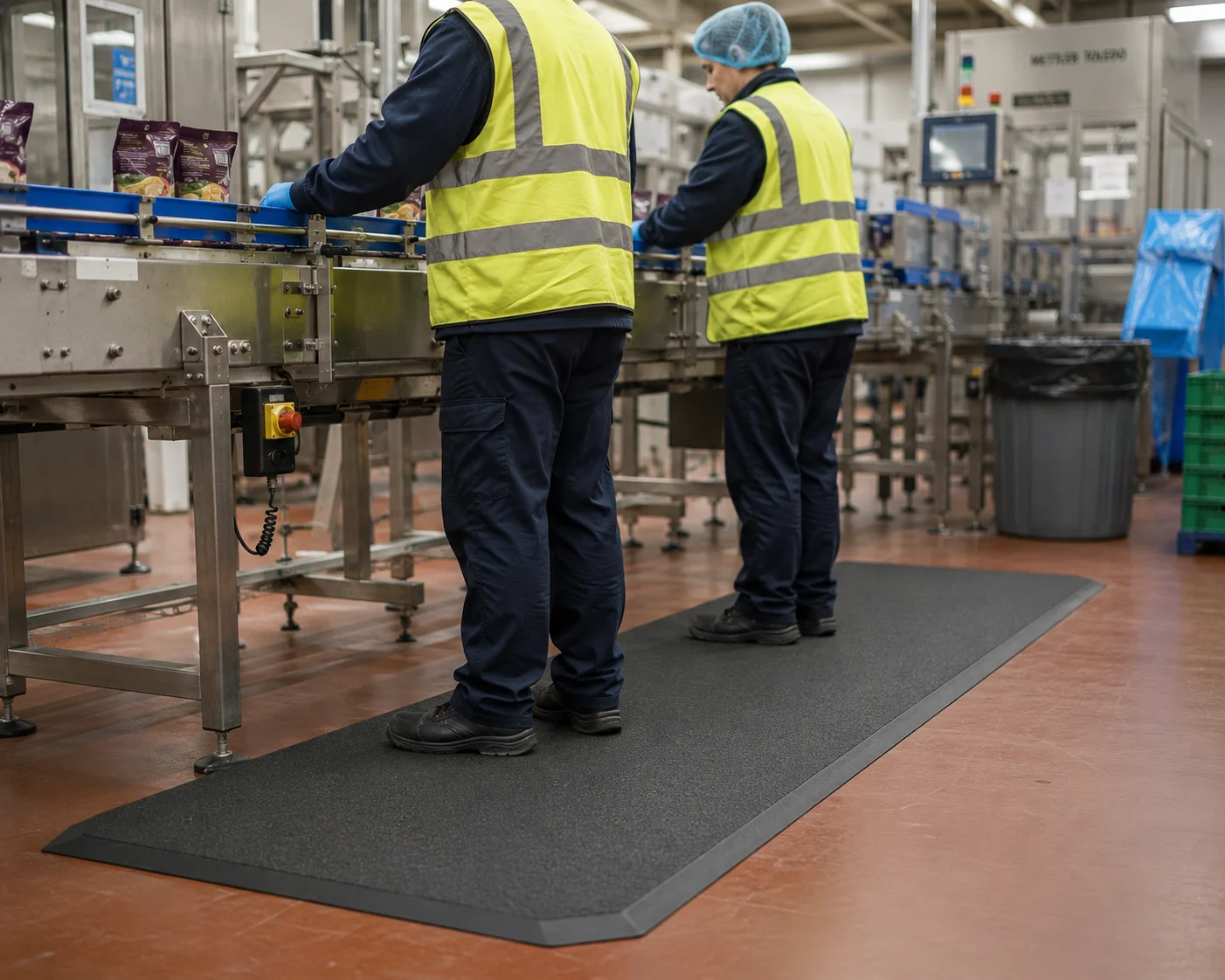
A single mat is fine for one person at one bench. Once you have a row of operators along a line, a long workbench or a packing run, separate mats leave gaps and edges, and those edges are where people trip and where trolley wheels catch. A roll of anti-fatigue matting covers the whole run in one piece.
This guide covers the two rolls we sell, M1 and M2, what sizes they come in, what they cost, when a full roll beats buying by the metre, and where a roll is the wrong choice.
Roll sizes at a glance
- Widths: 60 cm, 91 cm and 122 cm.
- Full roll length: 18.3 m (60 ft).
- Cut to length: any whole number of metres, same three widths, bevelled on all four sides.
- Full roll edges: bevelled along both long sides. The two ends are square cut.
- Thickness: 9.5 mm (M1) or 13 mm (M2).
- Made in: Belgium.
Width is the decision most people get wrong. 60 cm suits a single operator standing still at a fixed point. 91 cm gives room to shift weight and step back from the bench, and is the width we sell most of. 122 cm suits two-sided work, wide benches and anyone who moves around while they work.
Prices: cut to length vs full roll
Every price below is live from our catalogue. The black/yellow and grey versions of each range cost the same. The break-even column is the run length at which a full roll costs the same as buying that many metres cut to length. Past that point, buy the roll.
M1 comfort roll
9.5 mm · Light duty, up to about 3 hours of standing at a time. Surfaces: Black/yellow Elephant Skin or Grey Grid
| Width | Cut to length, per metre | Full roll, 18.3 m | Roll cost per metre | Roll is cheaper from |
|---|---|---|---|---|
| 60 cm | £26.66 ex VAT | £400.83 ex VAT | £18.25 ex VAT | 15.1 m |
| 91 cm | £35.83 ex VAT | £548.33 ex VAT | £24.97 ex VAT | 15.4 m |
| 122 cm | £47.49 ex VAT | £715.83 ex VAT | £32.60 ex VAT | 15.1 m |
M2 comfort roll
13 mm · Medium duty, full 8-hour standing shifts, R10 slip rated. Surfaces: Black/yellow Diamond Plate or Grey Bubble
| Width | Cut to length, per metre | Full roll, 18.3 m | Roll cost per metre | Roll is cheaper from |
|---|---|---|---|---|
| 60 cm | £44.99 ex VAT | £743.33 ex VAT | £33.85 ex VAT | 16.6 m |
| 91 cm | £64.99 ex VAT | £1,111.66 ex VAT | £50.63 ex VAT | 17.2 m |
| 122 cm | £84.99 ex VAT | £1,430.83 ex VAT | £65.16 ex VAT | 16.9 m |
Prices exclude VAT. VAT at 20% is added at checkout on UK orders. Roll cost per metre is the full roll price divided by 18.3 m.
M1 or M2: which roll?
Pick by how long people stand, not by the price per metre. A cheaper mat that flattens under an 8-hour shift is the expensive option by the second year.
M1 (9.5 mm, light duty) is resilient foam for standing up to about three hours at a time: retail and trade counters, light inspection benches, sit-stand areas and reception desks. Elephant Skin in black with yellow edges, or grey Grid.
M2 (13 mm, medium duty) is high-density foam for full 8-hour standing shifts on assembly, packing and production lines. It carries an R10 slip rating under DIN 51130. Diamond Plate in black with yellow edges, or grey Bubble.
If you are not sure, the M1 vs M2 guide goes into more detail, and we will post you free samples of both to stand on before you order.
How to work out how much you need
- Measure the standing zone, not the bench. Operators stand slightly back from the edge and step sideways. Add about 30 cm at each end of the run so nobody steps off the mat while reaching.
- Pick the width from how far people move front to back (see above).
- Round the length up to whole metres for cut to length.
- Compare against the break-even length in the table. If your run is longer, or you have several shorter runs that add up past it, a full roll is cheaper.
- Check the path across the mat. If pallet trucks or trolleys have to cross, a foam roll is the wrong product. See below.
Example: a 12 m packing line with operators on one side. Add 0.3 m at each end for 12.6 m, round up to 13 m of 91 cm M2. At the current price that is cheaper cut to length, because 13 m is under the 17.2 m break-even. A second, shorter line on the same order could tip it the other way.
For a fuller walk-through, including how to measure U-shaped cells and multiple stations, see the anti-fatigue mat sizing and coverage guide.
Laying a roll
- Clean and dry the floor first. Grit under a foam mat wears through the underside.
- Unroll it and let it relax. A roll that has been wound tight in transit can curl at the ends for a day or so. Leave it flat at room temperature before trimming anything.
- Keep bevelled edges on the walkway side. On a full roll, the long sides are bevelled and the ends are square. Butt the square ends against a wall, a machine plinth or a bench leg.
- Trim with a straight edge. A sharp utility knife and a steel rule are enough for foam. Score, then cut in several light passes.
- Do not tape it down permanently. You need to lift it to clean underneath.
When a roll is the wrong choice
Foam comfort rolls do one job well: they make standing on a hard, dry floor more comfortable. They are not built for the following, and we would rather tell you now than sell you the wrong thing.
- Oil, coolant, solvents or swarf. M1 and M2 have weak chemical resistance. Use M5 interlocking tiles, or the gritted anti-slip tiles if grip is the main worry.
- Wet or wash-down floors. Use drainage tiles so fluid falls through rather than pooling on the surface. Our anti-slip matting rolls guide covers this choice.
- Cold stores and freezers. M1 and M2 are rated for 10 °C to 70 °C.
- Welding and hot work. Neither roll is fire rated. See hot works matting.
- Wheeled traffic across the mat. Foam compresses under a loaded pallet truck. Use modular tiles with ramped edging.
- Electronics or EPAs. You need static-dissipative matting instead. See ESD matting.
If more than one of those applies, the modular vs roll matting comparison will help you decide.