Slips and trips are the most common cause of non-fatal injury at work in Great Britain, year after year. Anti-slip matting on a roll looks like the simple fix: unroll it, cut it, done. Sometimes it is. On an oily machining floor or a wash-down area it can make things worse, because the wrong roll holds liquid on top of it.
This guide explains the slip ratings you will see quoted, the main kinds of anti-slip roll, and which one fits which floor. It also says plainly where we think tiles are the better buy.
Start with what is on the floor
Before you look at any product, answer three questions:
- What makes it slippery? Water, oil, coolant, fat, dust, swarf or nothing at all?
- Do people stand there, or walk through? A walkway needs grip. A workstation needs grip and comfort.
- Does anything with wheels cross it? Trolleys and pallet trucks rule out soft foam.
A dry corridor needs very little. A bench where coolant drips all shift needs a surface that lets fluid drain away from the soles of people's boots. Those are different products.
Slip ratings: what R10 to R13 mean
Most matting in the UK is rated under the German DIN 51130 ramp test. A tester in safety boots walks on the sample, which is coated in motor oil, while the ramp tilts. The angle at which they lose their footing gives the R class.
| Rating | Ramp angle | Typical use |
|---|---|---|
| R9 | 6° to 10° | Dry indoor areas: offices, dry corridors |
| R10 | 10° to 19° | Occasionally damp floors, light production, stores |
| R11 | 19° to 27° | Regularly wet areas, workshops, food prep |
| R12 | 27° to 35° | Wet with grease or fat: commercial kitchens, dairies |
| R13 | Over 35° | Heavy oil, fat or coolant: machining bays, meat processing |
The HSE prefers the pendulum test, which gives a Pendulum Test Value (PTV) and can be run on your actual floor. A PTV of 36 or more means low slip potential. If your insurer or safety team has asked for a PTV, ask the supplier for one. An R rating alone will not answer that question. Our slip risk assessment guide covers how to put the two together.
The five common types of anti-slip roll
Ribbed or fluted rubber
Long ribs run the length of the roll. Cheap and hard wearing on dry walkways and ramps, but water and oil sit in the channels, so grip falls away fast once the floor is wet.
Best for: Dry corridors and ramps only.
Coin or stud rubber
Raised discs on a solid sheet. Looks tidy and cleans easily, which is why you see it in vehicles and plant rooms. Like ribbed rubber, it holds liquid on the surface rather than draining it.
Best for: Dry or occasionally damp floors.
Open-grid PVC (hollow section)
A flexible lattice that lets water fall through to the floor below. Good for showers, pool surrounds and wet entrances. Being soft PVC, it gives little comfort to someone standing for hours, and fats can make the top slippery.
Best for: Wet, barefoot or light-traffic areas.
Gritted safety tread
Aluminium oxide or carborundum grit bonded to a backing. The grit gives very high grip in oil and water, but the backing is thin and gives no cushioning, and the grit wears off under heavy traffic.
Best for: Steps, ramps and short runs where grip is everything.
Foam anti-fatigue roll with a textured top
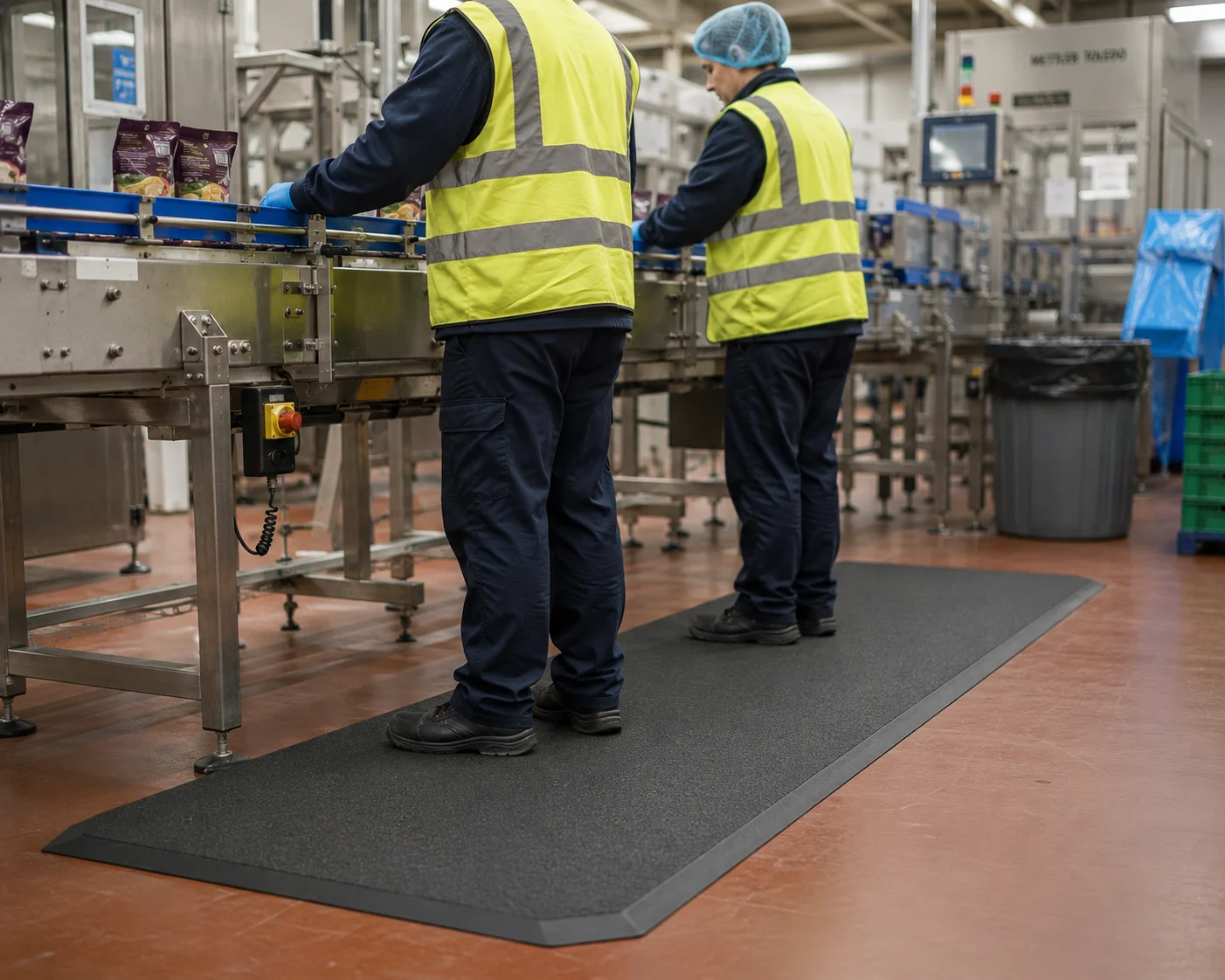
A comfort mat first, with a raised pattern that adds grip on dry or lightly damp floors. This is what our M2 roll is: 13 mm high-density foam, R10 slip rated.
Best for: Dry or lightly damp standing areas where people stand all shift.
Our roll: M2, R10, built for standing
The roll we sell is M2 Diamond Plate (black with yellow safety edges) and M2 Bubble (grey). It is 13 mm high-density foam with an R10 slip rating, made for people who stand at a line or bench for a full shift on a dry or occasionally damp floor.
- Widths of 60, 91 and 122 cm. Full rolls are 18.3 m.
- 91 cm full roll: £1,111.66 ex VAT. Cut to length: £64.99 ex VAT per metre.
- Long edges bevelled, with yellow edges on the black version so the mat is easy to see.
- Operating range 10 °C to 70 °C. Not for cold stores.
What it is not: an oil-resistant mat. M2 has weak chemical resistance, and oil and coolant will break the foam down. Do not put it where fluids land on it every day. Full sizes, prices and the break-even point between rolls and cut lengths are in our anti-fatigue matting rolls guide.
When tiles beat a roll
For oily, greasy or wet floors we recommend interlocking tiles over any roll. Three reasons:
- Drainage. Tiles with holes let fluid fall through to the floor below, so the surface people stand on stays drier. A solid roll holds the fluid on top.
- Higher grip. Our M5 anti-slip tiles have a gritted top rated R13, the highest DIN 51130 class.
- Repairs. Wear always concentrates where people stand. With tiles you replace the two that are worn, not 18 metres of roll.
R13 · solid top
M5 Anti-Slip Tile
Gritted interlocking tile for oily or dusty floors where fluid does not pool.
From £36.63 ex VAT
R13 · drainage
M5 Anti-Slip Drainage Tile
The same gritted top with drainage holes, for wet, wash-down and coolant areas.
From £35.79 ex VAT
Quick picker
- Dry walkway or corridor: a ribbed or coin rubber roll is enough.
- Dry or lightly damp standing area, long shifts: M2 roll, R10.
- Wet floor, people barefoot or in light shoes: an open-grid PVC roll.
- Oil, coolant or swarf at a workstation: M5 anti-slip drainage tiles, R13.
- Pallet trucks or trolleys crossing: heavy-duty tiles with ramped edging, not a roll.
- Steps and short ramps: gritted safety tread fixed to the surface.
For more on oily floors specifically, read anti-slip matting for oil and coolant. For a ranked comparison of mats on the UK market, see the best anti-slip mats in the UK.