Insights
Antimicrobial vs Antibacterial Mats: What UK Buyers Need to Know
Antimicrobial and antibacterial matting explained for UK food, laboratory and healthcare buyers, including testing, cleaning and product selection.
Antimicrobial and antibacterial are often used as if they mean the same thing. They do not quite mean the same thing, and neither term means that a mat can replace routine cleaning.
For facilities teams, the useful question is not which label sounds stronger. It is whether the mat suits the real hygiene risk, cleaning process, liquids, traffic and standing time in the area where it will be used.
This guide explains the difference, the evidence to request from a supplier and when an antimicrobial mat is worth specifying. It also compares solid and drainage formats for food production, laboratories, healthcare support areas and other hygiene-sensitive workplaces.
Antimicrobial vs antibacterial: the short answer
Antibacterial describes activity against bacteria.
Antimicrobial is a broader term. Depending on the treatment and the evidence behind it, it can refer to activity against bacteria and other microorganisms. The word alone does not prove which organisms have been tested.
In practical matting specifications, both terms may describe a material containing an active additive intended to inhibit microbial growth on the mat itself. The exact claim should be supported by the product documentation.
That last point matters. An antimicrobial mat is not automatically antibacterial against every species, antiviral, antifungal or suitable for direct food contact. Buyers should match the supplier’s specific evidence to the requirement instead of relying on the headline term.
What antimicrobial matting actually does
An antimicrobial mat normally contains an active additive within the material. On a suitable product, this helps inhibit the growth of specified microorganisms on the mat surface between cleaning cycles.
This is different from applying a disinfectant during cleaning. A disinfectant is used at a defined concentration and contact time to reduce microorganisms during the cleaning process. An integrated antimicrobial additive continues to form part of the mat after that process has finished.
The distinction is simple:
- Cleaning removes soil, grease and physical contamination.
- Disinfection reduces microorganisms when the correct product and process are used.
- An antimicrobial additive helps control tested microbial growth on the treated mat between cleans.
The additive is a supporting control, not a substitute for the first two steps. Food Standards Agency guidance still requires an effective cleaning and disinfection process for food environments. In healthcare and laboratory settings, the site’s own infection control or contamination control procedure remains the authority.
What ISO 22196 does and does not tell you
ISO 22196 is one of the most useful references when comparing antibacterial-treated plastics and other non-porous surfaces. It specifies a method for evaluating antibacterial activity on those treated surfaces.
If a mat supplier refers to ISO 22196, ask for enough detail to understand the claim:
- Was the finished mat material tested, or only the additive?
- Which bacterial strains were used?
- What reduction was recorded and after what contact time?
- Is the report current and traceable to the supplied product?
- Does the evidence cover the product colour and material being quoted?
ISO 22196 is not a general hygiene certificate. It does not show that a mat removes dirt, replaces disinfection or controls every type of microorganism. The standard itself is specifically concerned with evaluating antibacterial activity on treated non-porous surfaces.
This is why a clear, narrow claim is more credible than wording such as “germ proof” or “kills all bacteria”.
Antimicrobial does not mean self-cleaning
The most important buying rule is also the easiest to miss: antimicrobial matting still needs to be cleaned.
Food debris, oils, powders and biofilm can cover the surface and interfere with any treated material beneath. Soil also creates its own slip and contamination risks. In a wet area, liquid trapped on or under the mat can become a separate hygiene problem even when the mat contains an antimicrobial additive.
A workable maintenance plan should state:
- Who inspects the mat and how often.
- How loose debris is removed.
- Which detergent and disinfectant are approved.
- The required dilution and contact time.
- Whether the mat must be lifted to clean the floor beneath.
- How it is dried before being returned to service.
- What damage or wear triggers replacement.
Our industrial mat cleaning and replacement guide provides a practical starting point for documenting that process.
Solid or drainage antimicrobial matting?
The right surface format depends mainly on how much liquid reaches the floor.
Choose a solid surface when
- The area is normally dry.
- Occasional spills are dealt with immediately.
- Small components or tools could fall from the bench.
- Fast wipe-down cleaning is more important than fluid drainage.
- The floor beneath must be protected from routine drips.
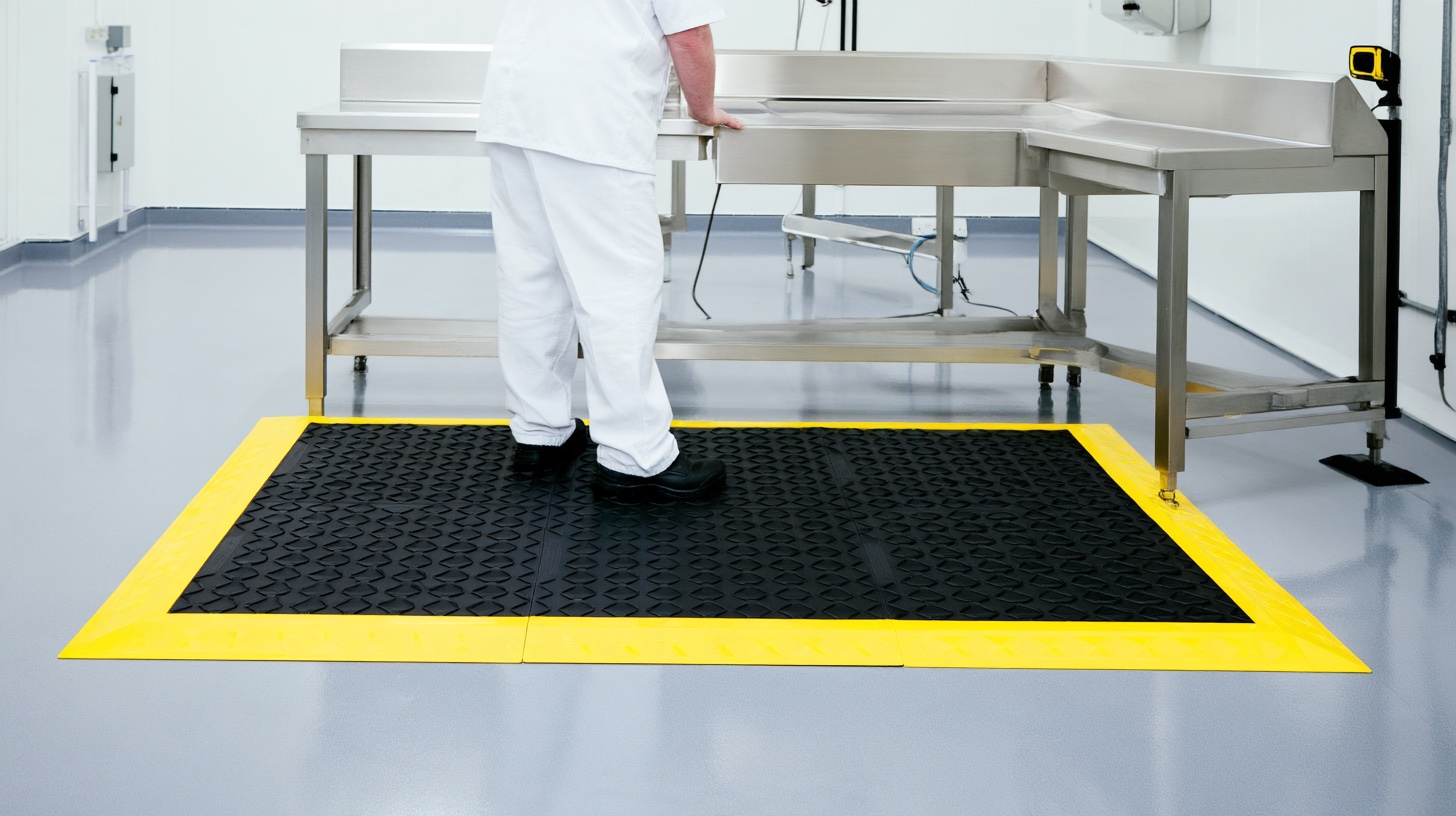
A solid surface is usually the cleaner choice beside dry packing benches, inspection stations, laboratories and controlled work areas where standing comfort is required but free-flowing liquid is not part of the process.
For a single station, the M-Lite Antimicrobial Anti-Fatigue Mat provides a 71 x 102 cm standing area with 20 mm cushioning. It suits buyers who want one complete mat rather than a tiled installation.
For wider or changing footprints, the M5 Antimicrobial Tile uses 46 x 46 cm interlocking modules. Individual tiles can be lifted and the layout can be extended or reconfigured as the workspace changes.
Choose drainage when
- Water, product residue or cleaning fluid reaches the mat routinely.
- Operators need to stand above wet floor conditions.
- The area is hosed or washed down.
- The cleaning plan includes lifting the mat and cleaning beneath it.
Drainage holes let liquid move away from the standing surface. They do not make cleaning optional. Openings and the floor below must remain part of the hygiene schedule.
The M-Lite Antimicrobial Drainage Anti-Fatigue Mat is the single-station option. For larger areas, the M5 Antimicrobial Drainage Tile creates a modular surface that can follow the required footprint.
Which workplaces benefit from antimicrobial matting?
Food production and packing
Antimicrobial matting can make sense at packing, preparation and inspection positions where staff stand for long periods and hygiene procedures are already established.
Choose the surface around the process. A dry packing bench may suit a solid mat. A wash-down area or wet preparation point is more likely to need drainage. Check chemical compatibility against the site’s detergent and disinfectant before ordering.
The mat should be included in the site’s cleaning schedule and hazard analysis. It should never be presented as making a workplace HACCP compliant by itself. For a broader specification, see our guide to drainage matting for food production.
Laboratories and quality control
Laboratories need a surface that can be cleaned consistently without creating a trip hazard or interfering with the work at the bench. In a normally dry laboratory, a solid antimicrobial anti-fatigue mat is usually easier to inspect and wipe down than an open drainage surface.
Where sensitive electronics are handled, antimicrobial performance does not replace ESD control. Resistance, grounding and footwear requirements must be assessed separately. Our laboratory and food production QC matting guide explains how to choose between comfort, hygiene and ESD requirements.
Healthcare and care environments
An antimicrobial mat may support a documented cleaning regime in selected non-clinical or support areas, such as sterile goods preparation, equipment processing or standing workstations. Suitability must be agreed with the site’s infection prevention team.
Do not assume that an industrial mat is appropriate for an operating theatre, isolation room or other clinically controlled area simply because it has an antimicrobial additive. The intended use, cleanability, chemical resistance and local infection control policy all need to align.
Hospitality kitchens and bars
Behind a bar or in a commercial kitchen, spills and long standing periods often occur together. A drainage anti-fatigue mat can help keep the standing surface clearer while providing cushioning. An antimicrobial version adds a useful secondary control between scheduled cleans.
The practical priorities remain grip, drainage, access for cleaning and a layout that does not create curled edges or trip points.
When standard matting is the better buy
Not every workplace needs an antimicrobial product.
Standard anti-fatigue matting may be the better value when the area is dry, hygiene risk is low and the mat is already cleaned effectively. Offices, ordinary assembly areas, dry warehouses and many machine-side positions usually gain more from choosing the right comfort rating, surface grip and size than from adding an antimicrobial treatment.
Likewise, a wet workplace with poor drainage does not become safe because the mat is antimicrobial. Fix standing water, cleaning access and slip risk first.
Pay for antimicrobial performance when it answers a defined requirement, not because it sounds reassuring on a specification sheet.
A seven-point buyer’s checklist
Before approving antimicrobial or antibacterial matting, ask:
- What is the intended area? Define the process, users and contamination risk.
- What evidence supports the claim? Request the relevant test method, organisms and result.
- Is the active treatment built into the material? Confirm whether it is integrated or only surface-applied.
- Is the area dry or wet? Choose solid or drainage construction accordingly.
- How will it be cleaned? Check detergent, disinfectant, temperature and contact-time compatibility.
- How long do people stand there? Hygiene performance does not guarantee suitable cushioning.
- How will the mat fit the floor? Allow for trolley routes, doors, workstation movement and access beneath the mat.
There is also a regulatory point for suppliers. HSE guidance on treated articles explains that products intentionally incorporating a biocidal product can fall within the GB rules for treated articles. Where a biocidal property is claimed, supporting information and labelling requirements may apply. A responsible supplier should be able to explain the treatment and provide relevant documentation.
Choosing a Maximum Matting product
Our antimicrobial range covers both fixed workstation mats and modular floor areas:
- M-Lite Antimicrobial: a solid 71 x 102 cm anti-fatigue mat for a single, normally dry station.
- M-Lite Antimicrobial Drainage: the same single-station approach with drainage for routine spills and wet conditions.
- M5 Antimicrobial Tile: 46 x 46 cm interlocking tiles for custom footprints and layouts that may change.
- M5 Antimicrobial Drainage Tile: modular coverage where liquid needs to move away from the standing surface.
- M5 Workstation Kits: pre-sized antimicrobial tile layouts for buyers who do not want to calculate a full floor plan.
You can browse all antimicrobial mats, request an M5 sample or send us the layout for help choosing a solid or drainage system. For larger food, laboratory or healthcare projects, we can assess the floor, cleaning process and standing positions before recommending a footprint.
The best antimicrobial mat is not the one with the broadest claim. It is the one with evidence that matches the site, a surface the team can clean properly and a format that solves the actual floor problem.