Insights
Anti-Fatigue Matting for Laboratories and Food Production QC: A UK Specification Guide
Specify anti-fatigue matting for UK labs and food QC rooms. Covers closed-cell foam, chemical resistance, ESD protection, and M-Series product selection.
- food-production-qc-matting
- lab-bench-matting-uk
- esd-lab-matting
- anti-fatigue-mat-chemical-resistance
- food-factory-qc-flooring
Anti-Fatigue Matting for Laboratories and Food Production QC: A UK Specification Guide
Lab technicians and QC analysts don’t get much coverage in matting discussions. Attention goes to production lines, warehouse aisles, and packing stations. But a QC analyst standing at an HPLC instrument for a seven-hour shift on an epoxy floor is accumulating exactly the same fatigue load as any packing operative.
The specification challenge is different, though. Laboratories and food production QC environments impose requirements that most standard anti-fatigue mats aren’t built for: chemical resistance, frequent wet cleaning, hygiene documentation, and sometimes ESD protection for sensitive instruments. This guide covers what to look for and which M-Series products fit where.
Why standard anti-fatigue mats fail in laboratory conditions
Most inexpensive mats are open-cell PVC foam. Functional enough on a dry production floor, but in a laboratory context they fail quickly and in ways that create problems beyond mere comfort.
Reagent spills saturate open-cell foam within seconds. The foam swells, loses its compression profile, and becomes a harbour for microbial growth. Routine lab cleaning agents, including IPA, bleach solutions, and quaternary ammonium disinfectants, attack the surface layer. Within weeks, the mat is peeling, curling, or chalking. Curled edges are trip hazards. Peeling surfaces shed particulate. Neither is acceptable in a QC or lab setting.
In food production QC rooms, the consequences go further. BRCGS and HACCP auditors examine flooring surfaces. A mat that cannot be demonstrably cleaned according to a documented schedule is a finding waiting to happen.
The fatigue load on laboratory workers
Hard epoxy, vinyl tile, and sealed concrete are standard in UK laboratories. These surfaces transmit ground reaction forces directly to the ankles, knees, and lower back with no absorption whatsoever. For someone cycling between a seated desk and a brief standing task, that is manageable. For a QC analyst, microbiologist, or sensory evaluator who stands continuously for six to eight hours, the cumulative effect is significant.
The body’s compensation mechanism on hard floors is to keep postural muscles under constant low-level tension to stabilise the skeleton. Over a long shift, that chronic tension exhausts the muscle groups involved, producing the lower-back tightness and leg fatigue that staff report most consistently. An anti-fatigue mat with appropriate compression characteristics introduces gentle micro-movements in the lower limbs, keeping circulation active and reducing that static tension.
The effect on error rates in the final two hours of a shift is worth considering. Sensory evaluation panels, manual pipetting, and any task requiring sustained concentration are all degraded by physical fatigue. The ROI data for anti-fatigue matting in production settings translates directly to QC and lab contexts, even if published research has tended to focus on factory floors.
Material requirements: what survives a lab environment
Closed-cell foam construction is the starting point. Unlike open-cell foam, it does not absorb liquid, so reagent spills stay on the surface and wipe clean. It also will not harbour microbial growth in its substrate, which matters in pharmaceutical and food QC environments alike. The M-Series uses closed-cell foam throughout.
Chemical compatibility needs checking against your specific agents. M-Series foam is REACH-compliant and phthalate-free, and performs well with IPA, dilute bleach, and standard quaternary ammonium disinfectants. For concentrated acids, high-alkalinity industrial cleaners, or aggressive solvents, verify compatibility with the product data before specifying.
Surface texture is a balance. Smooth tops clean with the least effort but can be slippery when wet. A moderate texture, such as the Elephant Skin pattern on the M1 or the Bubble surface on the M2 in grey, provides grip without creating areas that are difficult to wipe down. Both surfaces are solid-top with no drainage apertures, which is appropriate for bench-side standing zones where drainage is handled by the floor itself.
Dimensional stability under repeated cleaning is rarely discussed but matters considerably. Mats that curl at the edges after daily wet cleaning create trip hazards and look poorly maintained during audits. The M-Series maintains its profile under sustained use and frequent cleaning, which is what you need when the mat may be lifted, the floor beneath mopped, and the mat replaced every working day.
Food production QC: the hygiene dimension
If you are specifying for a QC lab on a food manufacturing site, hygiene criteria sit on top of the ergonomic requirements and carry more audit weight.
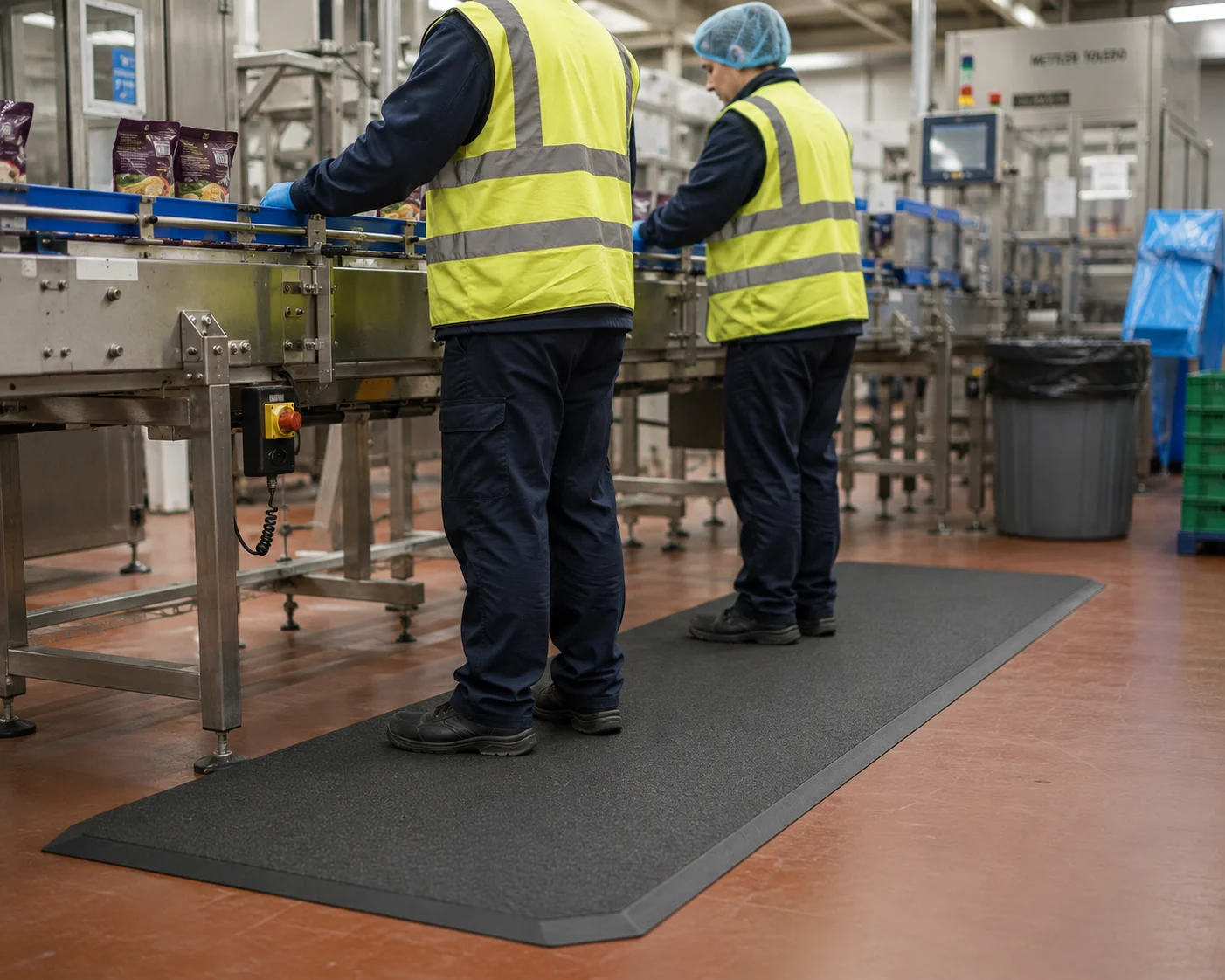
The mat surface must withstand the same cleaning chemicals used on the production floor. It must have no crevices or open seams where food particles can accumulate. Solid-top closed-cell mats in a single flat colour make visual inspection straightforward during pre-shift hygiene checks. Grey or black surfaces show soil clearly, which helps during routine checks and during external audits.
The M2 Bubble in grey suits this application well. It is solid-top, easy to inspect, straightforward to disinfect, and the high-density foam is built for full-shift standing. Documenting a cleaning and replacement schedule for matting in food production areas is good practice and increasingly expected by BRCGS auditors. The M-Series two-year warranty gives you a defined replacement horizon to build into that documentation.
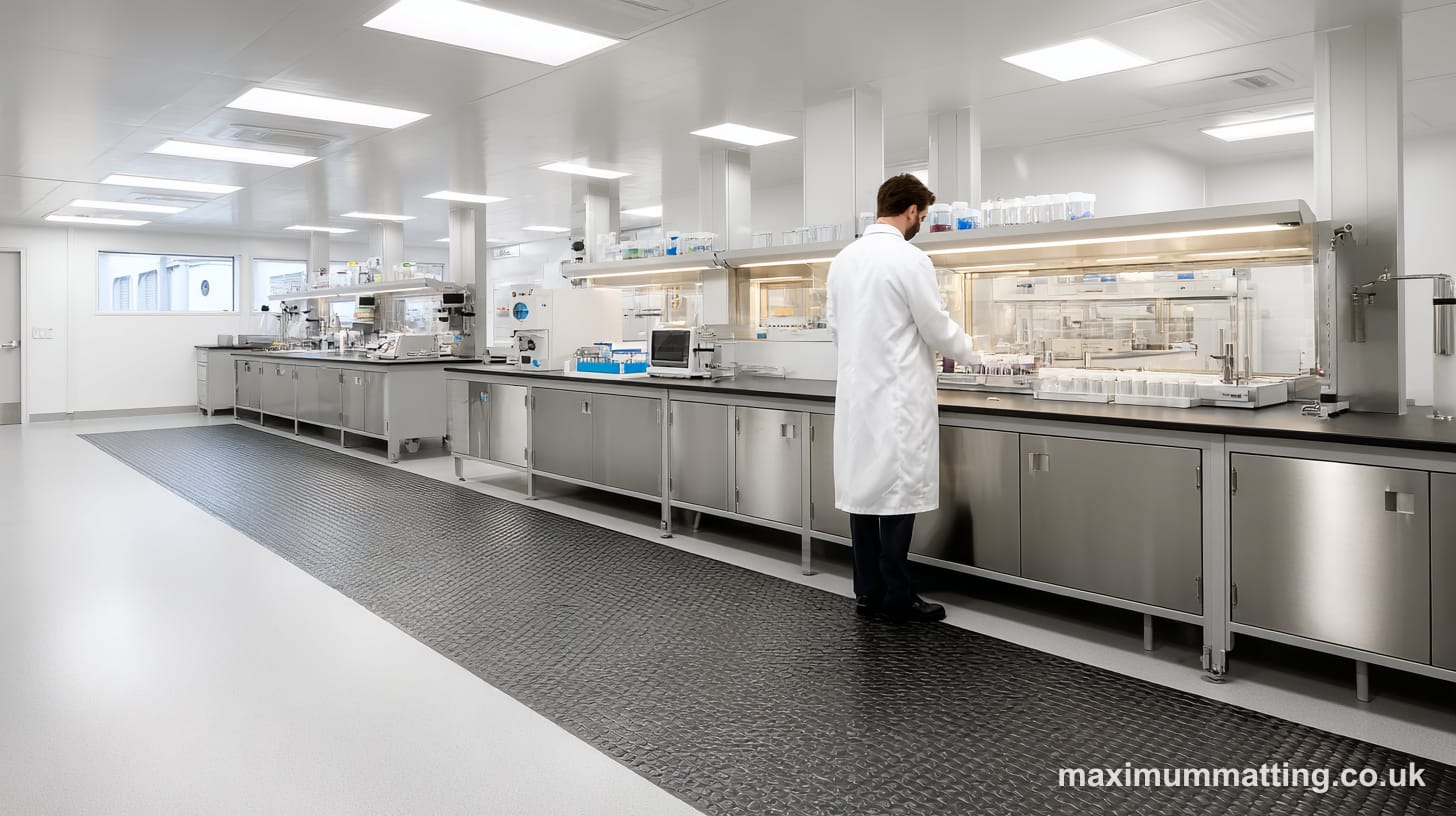
For larger QC rooms with multiple bench positions running along a wall, cut-to-length roll format avoids mat-to-mat junctions. Junctions accumulate debris, create minor trip points, and complicate cleaning records. A single continuous surface across the standing zone is cleaner in every sense.
When ESD matting belongs in the laboratory
More labs need ESD protection than assume they do. Electronic analytical balances, HPLC control units, benchtop spectrophotometers, PCR thermal cyclers, centrifuge controllers: all contain circuit boards sensitive to electrostatic discharge. Air-conditioned labs are often dry, particularly in winter, and low humidity makes static accumulation on operators straightforward. Charges of several kilovolts are possible without anyone noticing until something fails.
The ESD vs anti-static mats guide covers resistance ranges in detail. For laboratory environments, static-dissipative matting in the 10⁶ to 10⁹ Ω range is the right specification. It bleeds charge away at a controlled rate rather than holding it (anti-static) or conducting it to ground in a spike (fully conductive). Both extremes cause problems.
The M4 ESD floor mat addresses both requirements together: anti-fatigue comfort for standing operators and static-dissipative protection for sensitive instruments, from £39. For bench-level protection where operators are handling circuit boards or small components, the M3 bench mat starts at £23. Grounding accessories, including cable, earth bonding plug, wrist strap, and heel grounder, are available individually or as kits from £6 to £23.
For a food production QC lab that also houses electronic testing equipment, the M4 with a full grounding kit is typically the right specification.
Matching mat to shift pattern
This is where specification decisions often go wrong. The M-Series is explicit about shift length because comfort performance depends directly on it.
M1 (from £27): 9.5mm resilient foam, suited to standing up to around three hours. Appropriate for QC or lab staff who alternate between bench standing and seated analysis, or for positions where standing is only part of the working day. Elephant Skin texture in black or yellow. Lighter construction makes it easier to lift for daily cleaning.
M2 (from £47): High-density foam for continuous eight-hour shifts. The right choice for analysts at production-line sampling stations, microbiology labs, sensory evaluation rooms, or any position where standing is essentially unbroken. Diamond Plate or Bubble texture in black, yellow, or grey.
Underspecifying, using an M1 on an eight-hour shift, means the foam compresses beyond its working range by early afternoon and provides little benefit during the back half of the shift. That is precisely when fatigue is highest and errors most likely.
Sizing and format in practice
Individual QC bench positions typically work well with a standard mat size. For a 1200mm bench with a 700 os to750mm standing zone depth, a 600mm x 900mm mat leaves adequate clearance while covering the primary standing area. If the bench includes a sink or instrument extending the working zone, size up to 600mm x 1200mm.
For a multi-bench lab running the length of one wall, cut-to-length roll supply covers the standing area as a single uninterrupted piece. No junctions, no gaps, simpler to clean and simpler to document during an audit.
Specifying for your site
For a single bench position, the path is straightforward: determine shift length and ESD requirement, select M1, M2, M3, or M4 accordingly, and order online through our shop with secure checkout. Need help with the specification? Contact us before you order.
For larger QC rooms or full laboratory floors, particularly where ESD grounding continuity across multiple positions needs documenting, a free site visit is available. We measure the area, confirm standing patterns and cleaning requirements, and recommend formats before you commit to an order.
Order online for a single bench position, or book a free site visit for multi-bench QC rooms and ESD laboratory layouts.