Insights
Anti-Fatigue Mat Thickness Guide: 9mm, 12mm, 20mm or 25mm?
How thick should an anti-fatigue mat be? UK guide covering mat thickness, density, compression, trip risk, standing time, and how to choose the right workplace mat.
- anti-fatigue-mat-thickness
- how-thick-should-an-anti-fatigue-mat-be
- industrial-anti-fatigue-mat-thickness
- workplace-standing-mat-thickness
- anti-fatigue-mat-compression
Most buyers ask the thickness question first: is a 20mm anti-fatigue mat better than a 12mm one? Should a full-shift production worker be standing on the thickest mat available? Is a soft, spongy mat more ergonomic?
The short answer is this: anti-fatigue mat thickness matters, but it is not the whole specification. A thinner high-density mat can outperform a thicker soft foam mat if it holds its shape, spreads pressure evenly, and rebounds after use. A very thick mat can also create a trip hazard if it is placed in the wrong traffic route or supplied without suitable bevelled edges.
For UK workplaces, choose anti-fatigue mat thickness by standing time, density, compression recovery, floor risk, and environment, not by millimetres alone.
The quick answer: what thickness should you choose?
Use this as a practical starting point.
| Mat thickness | Best suited to | Watch-outs |
|---|---|---|
| 9-10mm | Part-shift standing, counters, sit-stand desks, light inspection benches | Not usually the right choice for continuous full-shift standing |
| 12-15mm | General workplace comfort, benches, lighter production roles | Check density and bounce-back, not thickness alone |
| 18-20mm | Longer standing periods, packing benches, commercial kitchens, production stations | Needs bevelled edges and good compression recovery |
| 20-25mm+ | Modular tiles, wet areas, drainage formats, heavier industrial workstations | Can be unsuitable across pedestrian routes if edges or ramps are poor |
That table is deliberately cautious. There is no universal “best” anti-fatigue mat thickness because the same measurement can behave differently across materials. A 20mm low-density foam mat that bottoms out under a worker by lunchtime is not a better mat than a 12mm dense industrial mat that keeps rebounding through the shift.
If workers stand intermittently for up to around three hours, a lighter mat such as M1 comfort matting may be the right fit. If they stand for a full shift in production, assembly, or packing, the specification should move towards a denser full-shift product such as M2 comfort matting. The M1 vs M2 guide covers that choice side by side.
Why thicker is not always better
Anti-fatigue mats work by creating a slightly yielding surface underfoot. That movement encourages small posture changes and reduces the effect of standing on hard concrete, resin, tile, or steel. But the mat still has to support the worker. If it is too soft, the foot sinks and stabilising muscles work harder. If it is too firm, the mat does not meaningfully reduce impact or pressure.
That is why the Canadian Centre for Occupational Health and Safety warns that softer and thicker mats may not always be better, and recommends choosing a mat with some elasticity without making the standing surface so soft that it feels unstable. The same guidance also flags sloped edges, cleaning, environmental suitability, and trip risk as part of the selection process.
For an HSE lead or facilities manager, that is the real lesson: thickness is a product dimension, not a performance guarantee.
Better questions are:
- Does the mat recover after repeated compression?
- Does it stay supportive at the end of the shift?
- Is it stable under the worker’s footwear?
- Are the edges bevelled, ramped, or otherwise controlled?
- Is the top surface suitable for the floor condition?
- Can the mat be cleaned without degrading?
If the answer to any of those is no, another 5mm of thickness will not fix the specification.
Thickness vs density vs compression
Three terms sit behind every good anti-fatigue mat specification.
Thickness is the physical depth of the mat, usually measured in millimetres. It affects the feel underfoot, the edge profile, and how much visible step-up the mat creates from the surrounding floor.
Density is how much material is packed into the mat. Higher-density foam, rubber, PVC, or polymer compounds resist permanent compression better than cheap open-cell foam. Two mats can both measure 20mm, but the denser one will usually hold its profile for longer under industrial use.
Compression recovery is the mat’s ability to return to shape after load. This is the difference between a mat that still feels supportive after six months and one that develops a permanent footprint where the operator stands. Compression recovery is especially important on packing lines, assembly benches, and quality inspection stations where the same worker stance is repeated all day.
This is why cheap, thick foam can feel impressive in a showroom and disappointing in service. It gives way easily at first touch, then collapses in the exact spot where support is needed most. The mat has thickness, but it does not have enough structure.
For a deeper look at how mats fail over time, see how long anti-fatigue mats last.
Match thickness to standing time
Standing time is the best filter before you compare thickness.
For part-shift standing, the operator may stand for short periods, alternate between sitting and standing, or move away from the workstation regularly. Reception counters, retail counters, trade counters, light maintenance benches, and sit-stand desks usually fall into this group. These areas do not always need the thickest mat. They need a stable, comfortable mat that is easy to position and does not create an avoidable trip edge.
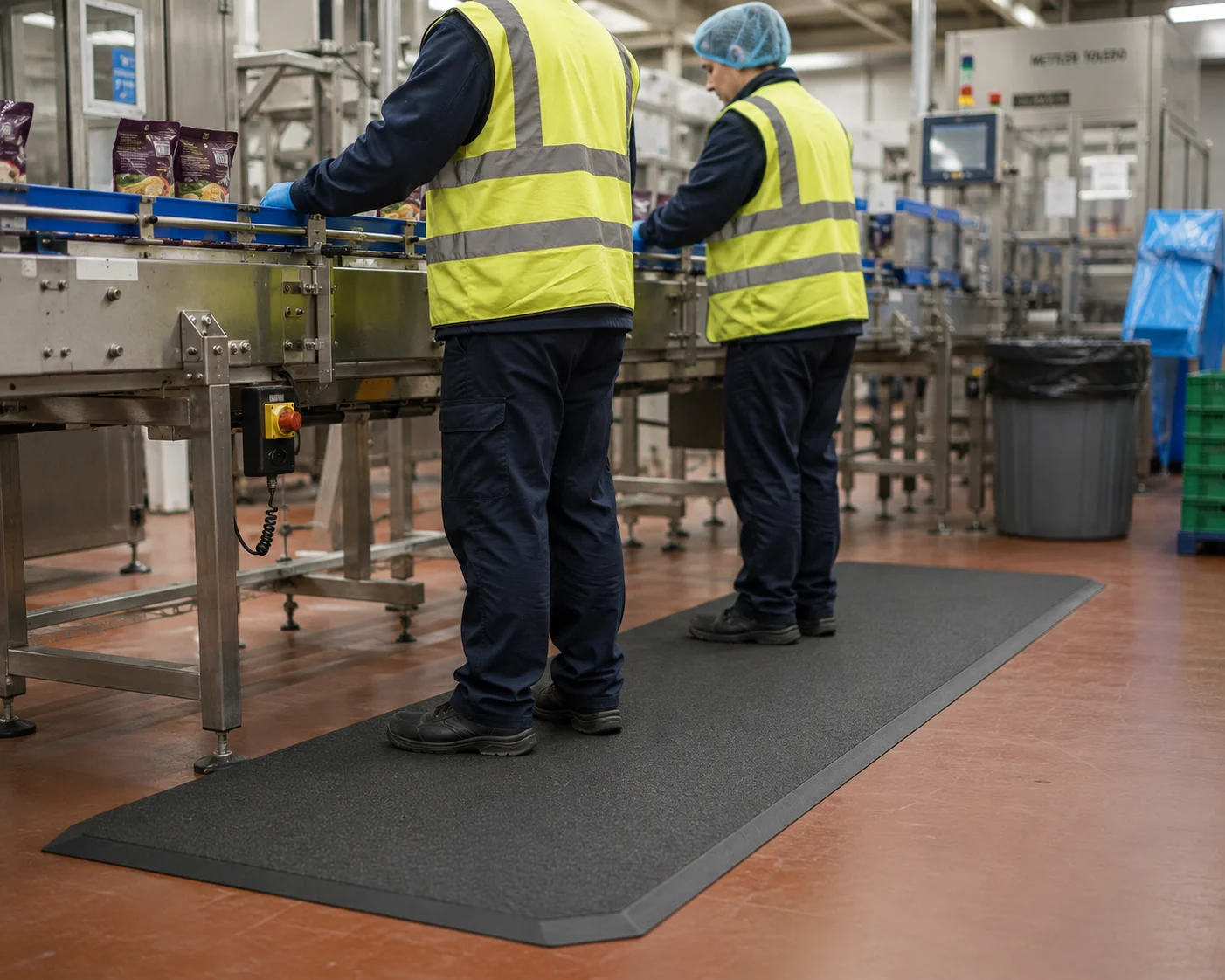
For full-shift standing, the worker is on their feet for most of an eight-hour shift or longer. Packing stations, production lines, assembly benches, and inspection cells are typical examples. Here, the issue is not just first-step comfort. The mat has to keep supporting after thousands of small weight shifts across the day. Density, pressure distribution, and rebound matter more than the headline thickness.
The anti-fatigue duty and standing-time guide explains this in more detail. As a simple rule:
- Up to around three hours or alternating sit/stand work: look at lighter anti-fatigue matting.
- Full standing shifts: specify a denser full-shift mat.
- Twelve-hour or multi-shift use: assess the whole workstation, not just the mat.
Our packing line article is a useful example of the full-shift case, where the operational benefit depends on consistent support through the working day rather than a soft first impression.
Thickness and trip risk
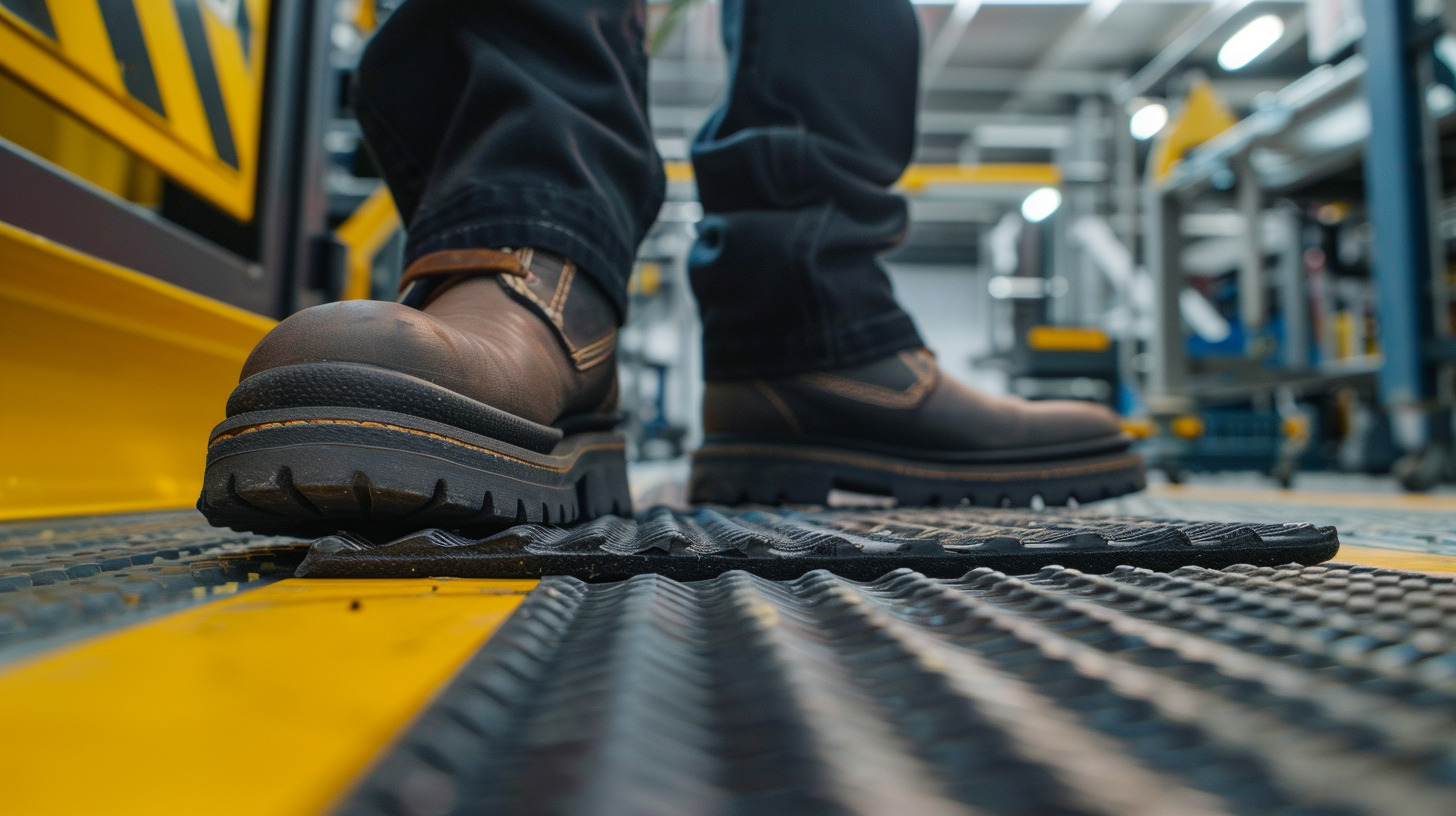
Every extra millimetre of mat thickness creates a larger transition from the surrounding floor. That does not make thicker mats unsafe, but it does mean the edge detail matters.
HSE guidance on floors and traffic routes is clear that floor surfaces should be kept free from conditions that create health and safety risk. In practical matting terms, a mat should not introduce curling edges, unstable movement, or an unexpected step where people walk, turn, push trolleys, or carry materials.
For thicker workplace mats, look for:
- Bevelled edges on loose-laid workstation mats.
- Ramps or edging on modular tile systems.
- Secure placement so the mat does not creep.
- Enough contrast where the edge needs to be visible.
- Inspection for curling, cracking, or delamination.
This is where a 25mm modular tile can be excellent inside a defined workstation footprint but poor if dropped loose across a busy pedestrian route. The product may be good; the placement may be wrong.
The anti-fatigue mat sizing and coverage guide is worth using before ordering because edge count, joins, and layout often matter as much as the mat itself.
Environment changes the answer
Thickness guidance changes once the floor environment changes.
Dry production and packing stations usually need resilient anti-fatigue support, good edge visibility, and enough density for the standing time. Thickness can sit in the middle of the range if the mat has strong rebound.
Wet or washdown areas may need drainage holes, raised profiles, or modular formats that let liquid move away from the standing surface. In those areas, thickness is partly about drainage geometry, not just comfort. Start with the drainage matting guide for food production if hygiene or washdown is involved.
Oily engineering and automotive areas need material compatibility. A comfortable foam mat that absorbs or degrades in oil is the wrong mat, however thick it is. The oil-resistant workshop matting guide covers that decision.
ESD workstations add another layer. The mat has to control static as well as support the operator. Do not put a normal anti-fatigue mat into an Electrostatic Protected Area just because the thickness looks right. Use the ESD bench and floor matting guide or the ESD mat grounding setup guide for that specification.
Hot works and welding bays need fire performance and surface durability. Thickness alone says very little about spark, slag, or heat exposure. Use the hot works matting guide for those areas.
A simple specification checklist
Before you choose a mat by thickness, run this checklist.
- How long does the operator stand in a normal shift?
- Is the standing continuous or broken by sitting, walking, or rotation?
- Is the floor dry, wet, oily, chemically exposed, or ESD-controlled?
- Will the mat sit inside a defined workstation or cross a traffic route?
- Does the mat have bevelled edges, ramps, or suitable edging?
- Will trolleys, pallet trucks, or wheeled equipment pass over the edge?
- Can the mat be cleaned in the way the site already cleans floors?
- Does the mat recover after compression, or does it bottom out?
- Is the mat large enough for natural foot movement?
- Is the specification recorded for future replacement and audit?
That last point is often missed. Anti-fatigue matting is not just a comfort purchase. In a workplace where prolonged standing is a known risk, it forms part of the control measure. HSE identifies prolonged standing as a cause of lower limb disorder risk and lists anti-fatigue matting as one possible control alongside job rotation, breaks, seating where possible, and better work design.
For the legal framing, see workplace matting and UK health and safety law.
What to avoid
Avoid choosing the thickest mat because it feels luxurious for the first ten seconds. A workplace mat is not a mattress. If it is too soft, unstable, or slow to recover, it can increase fatigue rather than reduce it.
Avoid placing thick mats where people do not expect a change in level. If workers walk across the edge repeatedly, push wheeled equipment over it, or turn while carrying goods, the edge detail has to be designed into the layout.
Avoid using one mat type across every department. Packing, ESD assembly, food washdown, CNC machining, and a reception counter can all need different matting even if the buyer asks the same thickness question at the start.
Avoid leaving worn mats in place. Once a mat has visible compression, curling edges, a smooth worn surface, or slow rebound, it may no longer be doing the job it was bought for.
The practical rule
For most UK workplaces, the best anti-fatigue mat is not the thickest mat. It is the mat that:
- Has enough thickness for comfort without creating uncontrolled edges.
- Has enough density to resist bottoming out.
- Recovers after repeated standing.
- Matches the operator’s standing time.
- Suits the floor environment.
- Can be cleaned and maintained.
- Is sized to the actual standing footprint.
If you are choosing between Maximum Matting M-Series products, start with the worker’s standing time. M1 suits lighter, part-shift standing roles. M2 is built for full standing shifts in production, packing, and assembly. If the site has mixed zones, wet floors, oil, ESD requirements, or unusual layouts, use the industrial matting selection guide or book a free site visit so the whole floor can be specified properly.
Thickness gets you into the right conversation. It does not finish the specification.
FAQs
Is a thicker anti-fatigue mat better?
Not always. A thicker anti-fatigue mat can be more comfortable if it also has the right density and rebound, but a thick soft mat can bottom out or feel unstable. Choose by standing time, compression recovery, edge safety, and environment as well as thickness.
What thickness anti-fatigue mat is best for an 8-hour shift?
For an 8-hour standing shift, look beyond thickness and choose a full-shift mat with higher density, strong pressure distribution, and good bounce-back. A 12-20mm dense industrial mat can outperform a thicker low-density foam mat.
Can anti-fatigue mats be too thick?
Yes. A mat can be too thick for a pedestrian route, trolley path, or tight workstation if the edge creates a trip risk. Thicker mats need bevelled edges, ramps, or controlled placement.
What causes an anti-fatigue mat to go flat?
The usual cause is permanent compression. Low-density foam collapses where the worker stands most often and does not fully recover. Heavy use, long shifts, heat, chemicals, and poor cleaning methods can all shorten mat life.
What is more important: thickness or density?
Density is usually more important for workplace performance. Thickness affects comfort and edge height, but density and compression recovery determine whether the mat keeps supporting the worker through repeated use.