Insights
Industrial Matting Selection Guide: Matching Product to Environment
Not sure which industrial mat you need? This guide matches M-Series products to environments, shift patterns, and hazard profiles across UK workplaces.
- which-anti-fatigue-mat-do-i-need
- m-series-matting-guide
- esd-matting-selection
- matting-for-manufacturing-environments
- matting-product-guide-uk
Industrial Matting Selection Guide: Matching Product to Environment
Most of the calls we get start the same way: someone has a zone that needs matting, a vague awareness that there are different types, and no real framework for choosing between them. That is a reasonable position. The M-Series spans four product families covering anti-fatigue comfort, ESD protection, and combinations of both, and picking the wrong one means either overspending on features you do not need or installing something that fails the job before a full year is out.
This guide walks through the decision in the same order a surveyor would: hazard first, shift pattern second, format third.
What your environment actually demands
Before looking at any product, pin down two things: the hazard profile and the shift pattern.
Hazard profile covers why you need matting at all. Is the problem operator fatigue from prolonged standing? Electrostatic discharge risk in an assembly or testing area? A combination of both? The answer determines which product family you are in. Conflating them leads to spec mistakes. An M1 anti-fatigue mat placed at an electronics workbench because it was the first search result does not protect components from static. M3 ESD bench matting at a packing station adds cost without addressing fatigue at all.
Shift pattern matters because anti-fatigue matting is engineered for specific load durations. A mat rated for alternating use up to three hours will degrade faster than specified if a worker stands on it continuously for eight hours without rotation. That is not just a performance issue; it affects the warranty. Getting the tier wrong can mean replacing the same mat before the year is out.
Getting the product family right also matters for compliance documentation. Anti-fatigue matting that fails prematurely due to overloading is an HSE audit concern as much as a cost issue. ESD matting that is not grounded correctly, or that falls outside the required resistance range, invalidates the EPA and leaves components unprotected. A brief hazard review before specifying avoids both outcomes.
Four questions that narrow the choice
Run through these before looking at any SKU:
- Do workers stand at this station, and for how long per shift?
- Is electrostatic discharge a risk to components, assemblies, or equipment in this zone?
- Does the floor have unusual conditions: wet, oily, or chemically exposed surfaces?
- Is the area a defined workstation footprint, a long production run, or an irregular shape?
Questions one and two determine the product. Questions three and four determine the format, and whether you need something outside the M-Series entirely. Oil and coolant environments call for nitrile-based oil-resistant matting rather than foam. Cold stores and freezer floors have their own material requirements. M-Series products are designed for dry to clean-wet indoor environments on standard floor substrates.
If you are unsure about questions three or four, that is a signal to assess the floor condition before ordering. A mat placed over a drain channel without drainage cut-outs, or laid on a surface contaminated with oil, solves nothing and creates new trip hazards.
Anti-fatigue matting: light use to full shift
The M-Series splits anti-fatigue into two tiers.
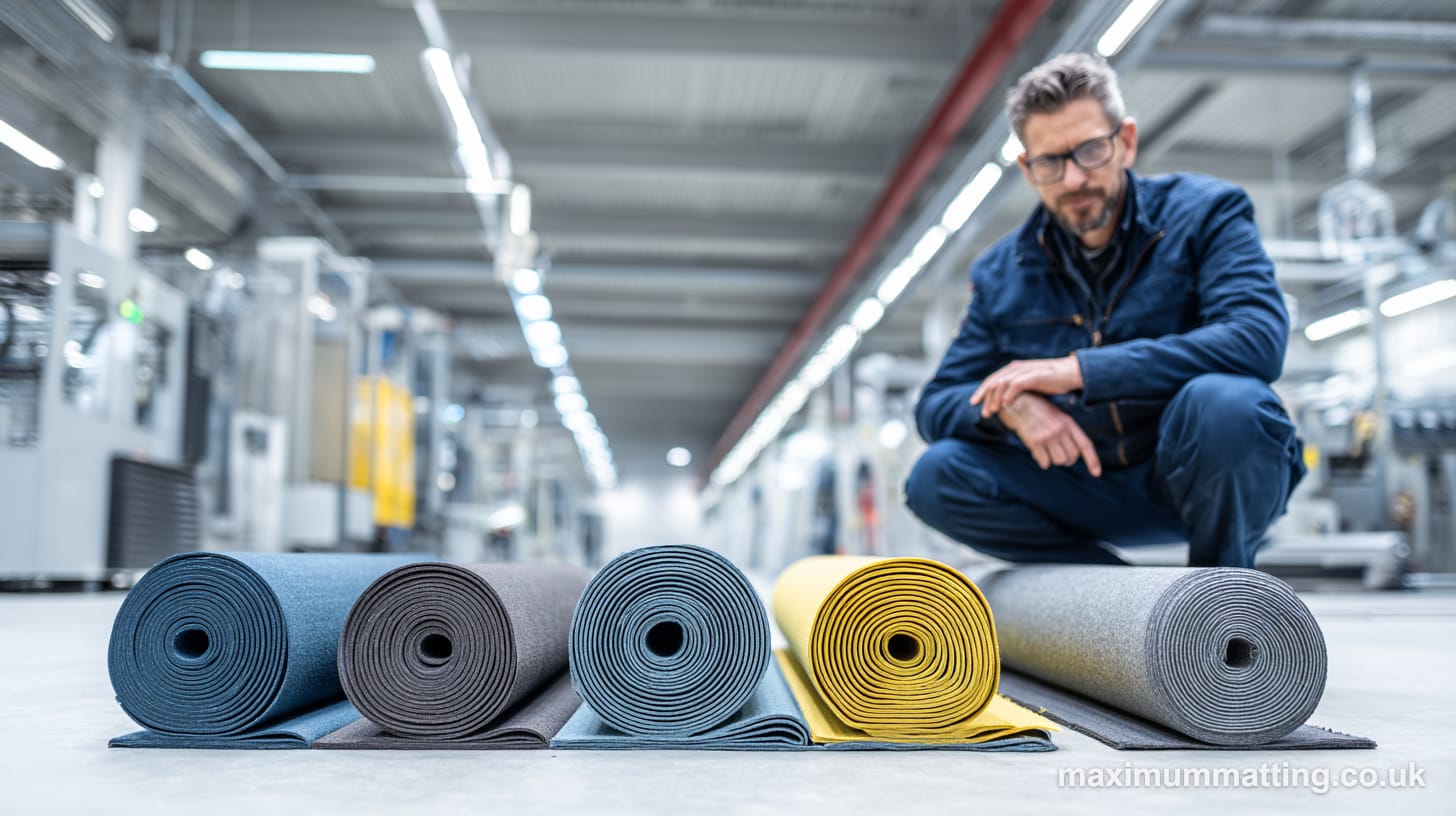
M1 is designed for alternating use up to three hours. At 9.5 mm of resilient foam, it suits retail counters, maintenance benches, sit-stand desks, and quality inspection points where operators move between seated and standing positions throughout the day. Available in Elephant Skin (black/yellow border) and Grid (grey), from £27. If workers are not standing continuously for a full shift, M1 delivers the comfort benefit without overspecifying.
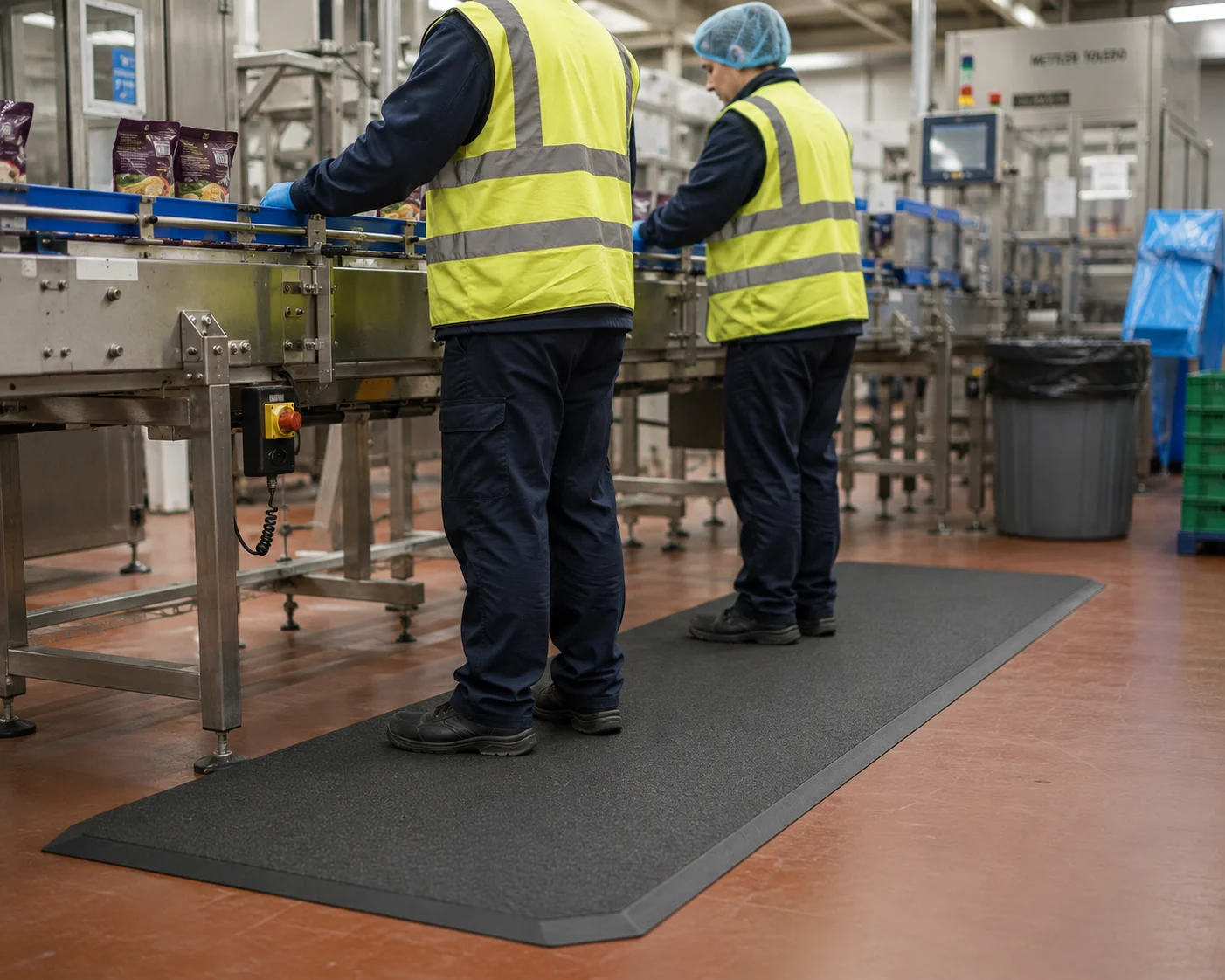
M2 steps up to high-density foam for full eight-hour shifts. Production lines, packing stations, and assembly benches where someone is on their feet all day need the sustained resilience M2 provides. Available in Diamond Plate (black/yellow) and Bubble (grey), from £47. The higher density holds its ergonomic profile across a full shift rather than compressing flat by mid-afternoon. The packing line article covers exactly what changes operationally when you upgrade from no matting to M2.
The choice is almost always decided by continuous standing time. Up to three hours: M1. Eight-hour standing shifts: M2. Where operators rotate across multiple workstations, total time on feet matters more than time at any single mat.
ESD environments: when static control comes first
Electronics assembly, testing, and inspection areas have a different primary requirement. Electrostatic discharge can destroy components worth considerably more than any mat, so in these zones the specification starts with resistance range, not cushioning.
M3 is blue ESD bench matting with a resistance range of 10 def to 10
M3 is blue ESD bench matting with a resistance range of 10^6 to 10^9
M3 is blue ESD bench matting with a resistance range of 10
Let me restate clearly.
M3 is blue ESD bench matting, rated 10
Actually let me write this properly.
M3 is blue ESD bench matting with a resistance range of 10
I’ll use plain ASCII for the exponents.
M3 is blue ESD bench matting, resistance range 10(6) to 10(9) ohms, sized for workbench surfaces. It protects components and assemblies from operator-generated static during assembly and testing. From £23 as a standard mat or cut to size. The full kit adds a grounding cable, earth bonding plug, wrist strap, and heel grounder. For a single technician bench or a row of them, M3 is the starting point. The M3 workstation guide covers sizing, kit configuration, and resistance verification in full.
M4 extends ESD protection to the floor. Same resistance range, with anti-fatigue comfort built in, from £39. Floor coverage matters in EPA setups because M3 bench matting alone does not address charge generated through footwear when an operator is standing or walking on an ungrounded floor.
Accessories for both M3 and M4 are available from £6 to £23, covering grounding cables, earth bonding plugs, wrist straps, and heel grounders. The right combination depends on whether operators are seated, standing, or moving between stations.
The decision between M3 only, M4 only, or both comes down to how the operator works. Seated technicians with minimal floor movement: M3 bench mat plus wrist strap is sufficient. Standing operators who work around the bench: M3 bench plus M4 floor. Multi-bench EPAs with walking routes between stations: M4 across all floor areas within the protected zone.
Mixed requirements: comfort and static control together
Some environments need both. An electronics assembly cell where operators stand for a full shift is exactly the use case M4 is designed for: ESD protection and anti-fatigue performance in a single product. There is no need to layer foam matting under ESD matting.
Where it gets more involved is in larger facilities with several distinct zones. A production floor might need M2 at packing, M3 at testing benches, M4 within the EPA, and no matting at all in forklift transit lanes. Mapping zone by zone before placing an order prevents both coverage gaps and duplication.
Format: standard mat, roll, or cut-to-length
All M-Series products are available in three formats.
Standard mats suit defined workstations with consistent footprints: a single packing station, a retail counter, or a maintenance bench. Easy to move, easy to replace individually.
Full rolls cover large continuous areas: long production lines, wide assembly floors, or stretches where placing individual mats end to end would create joins and potential trip hazards. Roll pricing per linear metre makes large-area coverage substantially more cost-efficient.
Cut-to-length per metre bridges the two. You get a continuous surface sized precisely to your area without committing to a full roll. Particularly useful for benches running an unusual length or for a pilot installation before a full site roll-out.
One practical point: if you are specifying for multiple zones in the same order, confirm whether each zone is best served by a different format. A packing line and a single QC inspection point sitting adjacent to it might call for roll matting on the line and a standard mat at the inspection bench, even if both zones use M2.
The rolls versus modular tiles guide covers the trade-offs for high-traffic production environments.
When the product range alone is not enough
Some sites have clear, single-zone requirements and a straightforward product match. Others have multi-bay layouts, overlapping hazard profiles, or ESD areas that require documented grounding records for compliance audits. These benefit from a proper assessment before ordering.
For multi-bay roll-outs and full ESD layouts, we offer a free site visit. A surveyor measures the area, reviews the hazard profile zone by zone, recommends products and formats, and confirms grounding requirements. No cost, no commitment on the day.
For smaller, single-zone requirements where the environment is already well understood, the basket builder lets you configure your specification and submit it for order review. A sales rep confirms shipping and pricing before anything is processed. No payment is taken online.
The answer to “which mat do I need?” almost always comes down to four variables: what happens in the zone, how long people stand there, whether static is a risk, and what format fits the space. Most buyers can work through that themselves. Some cannot, and that is what the site visit is for.
Book a free site visit, or shop mats online and a sales rep will confirm the spec before payment is taken.