Insights
Anti-Fatigue Matting on a 12-Hour Packing Line: What Actually Changes
Anti-fatigue matting on a packing line reduces operator fatigue and injury risk. Find out what actually changes on a 12-hour shift.
- anti-fatigue matting uk
- anti-fatigue matting packing line
- operator fatigue factory floor
- industrial matting uk
- factory floor safety matting
- standing fatigue manufacturing
- recycled matting uk
- british manufactured matting
- anti-slip matting uk
- packing line ergonomics
- musculoskeletal risk factory
- anti-fatigue mat thickness
Buy anti-fatigue mats online — from £16.95 · in stock · free UK delivery from £75
Shop anti-fatigue mats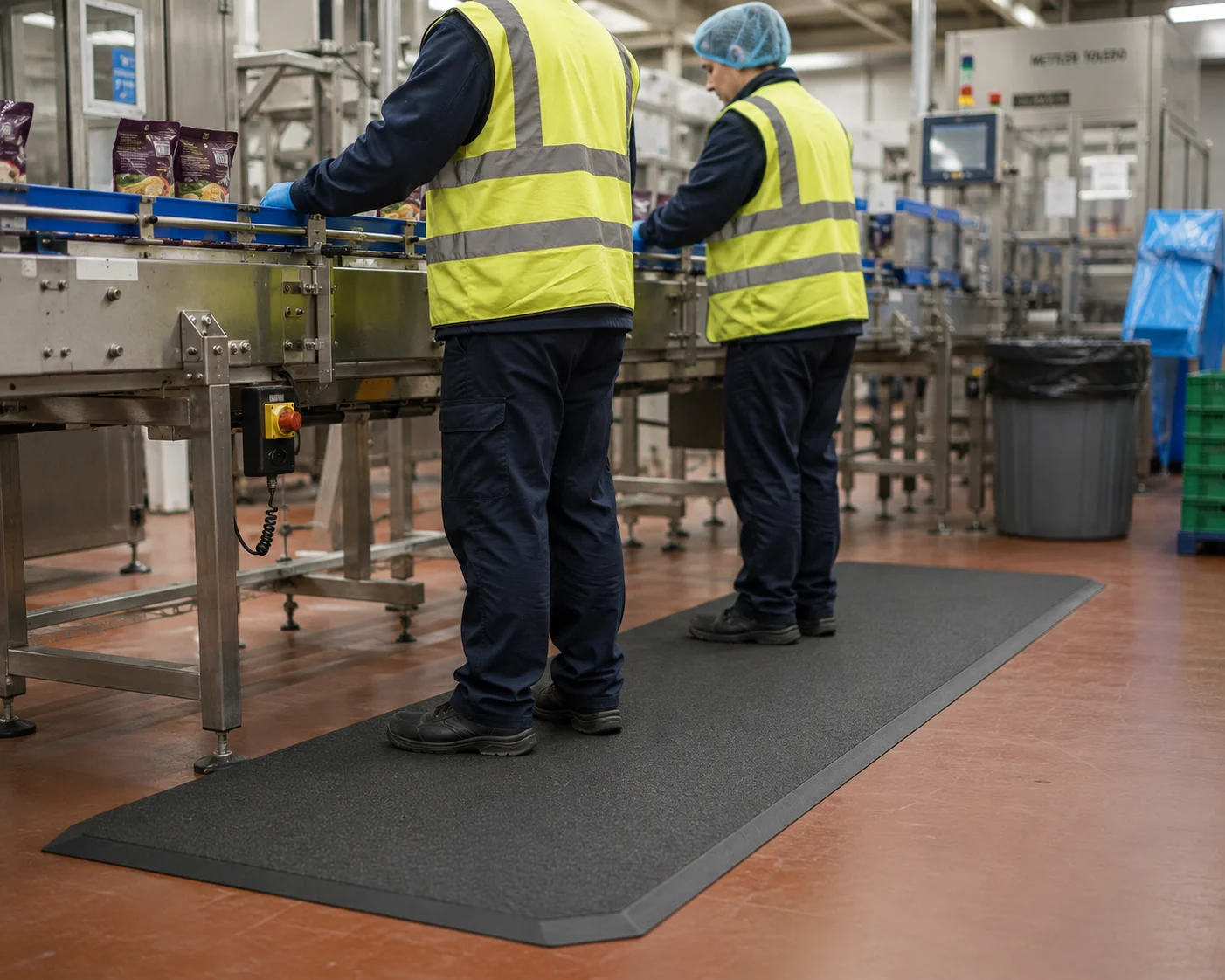
A packing operative stands at the same station for the first four hours of a twelve-hour shift. The concrete beneath the conveyor is bare. By hour six, the complaints start: sore feet, aching lower back, stiff knees. By hour ten, output slows, error rates climb, and the line supervisor is fielding requests for early breaks. This is not an unusual story. Our team hears it regularly from production directors and facilities managers across UK food, logistics, and consumer goods sites.
The tension is straightforward. You need people to stand, move, and concentrate at pace for long periods. Concrete and steel plate floors are hard, cold, and entirely unforgiving. The body compensates by tensing the muscles of the calf, thigh, and lower back to maintain posture, and that sustained static muscular effort is what drives fatigue. The cost of doing nothing is measurable in absence rates, musculoskeletal disorder claims, reduced throughput in the final hours of a shift, and the slower, harder-to-quantify erosion of operator morale.
What Fatigue Is Actually Doing to Your Operators
Fatigue from prolonged standing is not simply tiredness. It is a physiological response to restricted blood flow and sustained low-level muscle contraction. When an operator stands on a rigid surface, the muscles in the legs and lower back contract continuously to hold posture. That contraction compresses blood vessels, reducing circulation to the working tissue. Reduced circulation means reduced oxygen delivery and slower removal of metabolic waste products, which is the mechanism behind the burning, aching sensation that operators describe from mid-shift onwards.
The Health and Safety Executive identifies prolonged standing as a significant risk factor for musculoskeletal disorders, particularly affecting the lower back, hips, knees, and feet. Musculoskeletal disorders are consistently among the leading causes of work-related absence in UK manufacturing. For a packing line running two or three shifts, the cumulative exposure across a workforce is substantial.
Anti-fatigue matting interrupts this cycle because it introduces a degree of instability underfoot. The mat surface flexes slightly under load, which encourages the small, continuous micro-movements of the foot, calf, and leg that pump blood back up through the venous system. The operator is not consciously aware of these adjustments. They simply notice, over time, that their legs feel less heavy and their concentration holds longer into the shift.
The Material and Thickness Decisions That Determine Whether a Mat Works
Not every mat sold as anti-fatigue performs equally, and the difference is almost entirely in the compound and the thickness. A thin, closed-cell foam tile placed on a concrete floor will compress fully under a standing adult within weeks and offer no meaningful deflection thereafter. A mat manufactured from the correct compound at the correct thickness will maintain its performance characteristics across years of continuous use. These are the principles behind our M-Series anti-fatigue range.
For a packing line environment, the relevant variables are:
- Compound. Nitrile rubber and natural rubber compounds offer the best combination of deflection, recovery, and durability on hard industrial floors. Our matting is manufactured from 100% recycled compound, which delivers equivalent mechanical performance to virgin rubber while meeting the sustainability credentials that procurement teams increasingly require.
- Thickness. For standing workstations on concrete, a thickness of at least 12mm is the practical minimum for meaningful fatigue reduction. Positions where operators stand for extended periods without significant movement benefit from thicker profiles, typically in the 15mm to 20mm range, where the additional deflection supports greater micro-movement stimulation.
- Surface texture. A slightly textured surface improves grip underfoot and reduces slip risk, which matters on a packing line where spillage of product, condensation, or cleaning fluids is a regular occurrence. Anti-fatigue matting and anti-slip matting are not mutually exclusive. The right specification addresses both.
- Edge profile. Bevelled or ramped edges reduce the trip hazard at mat perimeters. On a busy packing line with trolleys, pallet trucks, and operators moving quickly, a square-edged mat is a foreseeable incident waiting to happen.
For food production environments specifically, the compound must also be resistant to oils, fats, cleaning chemicals, and high-pressure washdown. A mat that degrades under your cleaning regime is not a safety asset; it is a new hazard.
What Changes on the Line After Installation
Our clients report a consistent pattern in the weeks following installation of correctly specified anti-fatigue matting uk on their packing lines. The changes are not dramatic on day one. They accumulate.
In the first week, operators notice the difference in how their feet and legs feel at the end of a shift. The specific feedback we hear most often is that the aching that normally sets in from mid-shift is either absent or significantly delayed. That is the direct physiological effect of improved circulation and reduced static muscle load.
Over the following weeks, the downstream effects become visible to supervisors and managers:
- Error rates in the final hours of a shift reduce. Fatigue degrades concentration and fine motor control. When operators are less fatigued, their accuracy on tasks such as label application, weight checking, and seal inspection holds up better through the full shift duration.
- Break frequency and duration normalise. Operators who are in pain seek relief. Informal additional breaks, slower return from scheduled breaks, and increased time spent sitting on available surfaces are all fatigue responses that cost line output. Reducing the underlying fatigue reduces these behaviours without any management intervention.
- Absence related to lower limb and back complaints reduces over time. This is the hardest metric to isolate because musculoskeletal absence has multiple causes, but facilities managers at sites where we have supplied matting consistently report a downward trend in short-term absence linked to standing-related complaints.
- Operator retention and recruitment conversations change. In a tight labour market, the physical conditions on a packing line are a factor in whether people stay. Operators talk to each other and to agencies. A line that is known to be physically demanding in a punishing way is harder to staff.
None of these outcomes require a change in process, equipment, or staffing. They follow from placing the correct matting under the people already doing the work.
Specifying Matting for a Packing Line: The Practical Decisions
The specification process for anti-fatigue matting on a packing line is more straightforward than many facilities managers expect, but there are decisions that matter.
Zone mapping. Not every square metre of a packing line needs the same matting. Primary standing stations, where operators are stationary or near-stationary for the majority of their time, need the highest-specification anti-fatigue profile, such as our M2 Series anti-fatigue mats, which are engineered for full standing shifts. Walkways and transit areas need anti-slip matting that allows safe movement rather than the deflection-focused profile of an anti-fatigue mat. Mapping these zones before ordering prevents both over-specification in low-dwell areas and under-specification where it matters most.
Interlocking versus roll formats. Interlocking tile systems allow precise coverage of irregular station footprints and are easier to replace in sections if a tile is damaged. Roll formats are faster to install over long, regular runs and have fewer joints where product debris can accumulate, which is a hygiene consideration in food environments. The right choice depends on your line geometry and your cleaning protocol.
Cleaning compatibility. Specify the cleaning chemicals and methods you use before selecting a compound. Nitrile rubber performs well against oils and many industrial detergents. Some compounds degrade under specific alkaline or acidic cleaners. Our team will confirm compatibility before supply to avoid the situation where a mat that looked correct on paper fails early because of chemical incompatibility with your washdown regime.
Recycled content and sustainability documentation. Our matting is manufactured from 100% recycled compound and is British manufactured, which supports both sustainability reporting and supply chain resilience. For procurement leads managing environmental targets or supplier questionnaires, we can provide material composition documentation on request.
The Chartered Institute of Ergonomics and Human Factors publishes guidance on workstation design for standing tasks that is directly relevant to packing line specification. Their guidance reinforces that floor surface is a primary variable in standing workstation ergonomics, not an afterthought.
What You Can Do This Week
Walk your packing line at the end of a shift, not the beginning. Observe where operators are shifting their weight, leaning against equipment, sitting on surfaces not designed for sitting, or moving their feet frequently to relieve discomfort. These are the stations where fatigue is active and where matting will have the most immediate effect.
Note the floor surface at each of those stations. Is it bare concrete, painted concrete, steel plate, or existing matting that has compressed and lost its profile? Compressed or bottomed-out matting provides no anti-fatigue benefit and may actually be worse than a flat surface because it creates an uneven footing.
Take photographs and dimensions of the three highest-dwell stations on the line. That is enough information to begin a specification conversation with our team. You do not need a full site survey to get started, though we do offer site assessments for larger or more complex installations.
The specification does not need to be perfect across the whole line on day one. Starting with the highest-impact stations, seeing the operator response, and expanding from there is a sensible approach that also makes the business case easier to build internally.
If you are ready to specify anti-fatigue matting uk for your packing line, contact our team at Maximum Matting with your station dimensions and floor surface details, and we will return a specification and lead time within one working day.