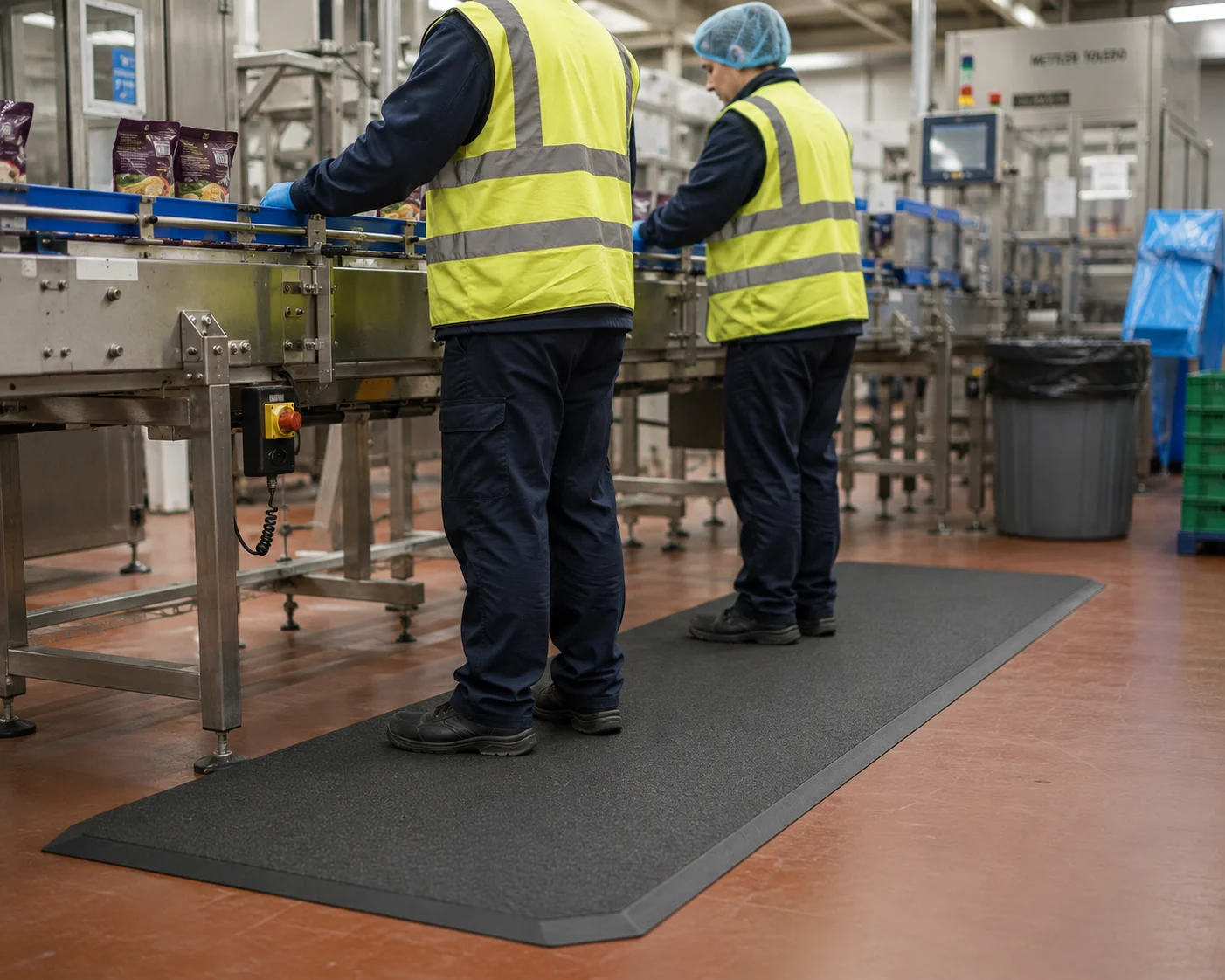
Insights
Matting for 24/7 Logistics Operations: Specifying for Continuous Shift Patterns and High-Traffic Aisles
Specify industrial matting UK logistics sites can rely on across continuous shifts. Learn materials, thicknesses, and placement for high-traffic aisles.
- industrial matting uk
- anti-fatigue matting uk
- logistics matting
- heavy duty matting
- factory floor safety matting
- recycled matting uk
- british manufactured matting
- anti-slip matting uk
- drainage matting uk
- continuous shift matting
- warehouse aisle matting
- high traffic matting
Buy anti-fatigue mats online — from £16.95 · in stock · free UK delivery from £75
Shop anti-fatigue mats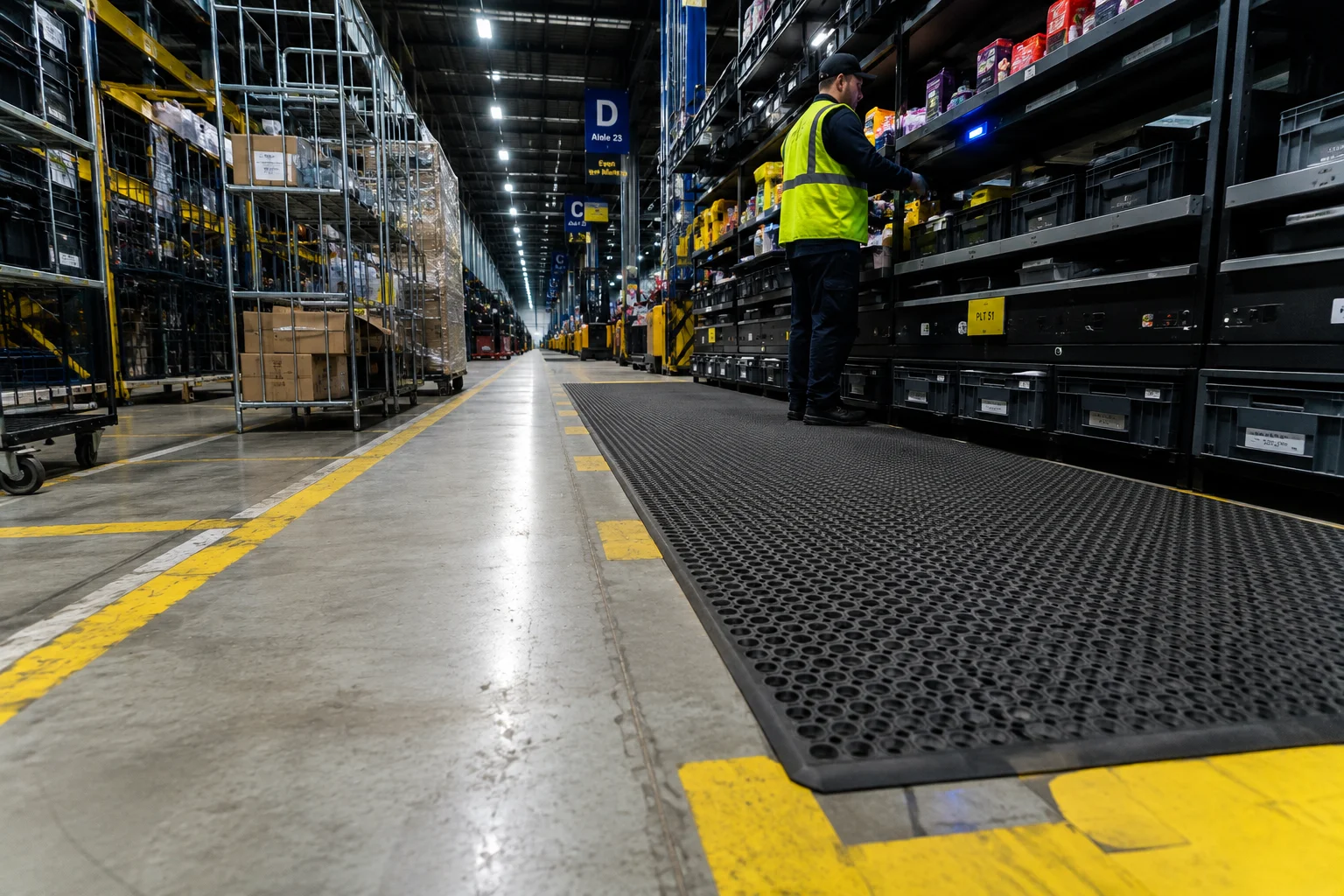
A picker on a midnight shift walks a distance comparable to a half-marathon before the sun rises. The floor beneath them never changes, the lighting rarely improves, and the matting, if it exists at all, was specified for a single-shift operation that no longer reflects how the site actually runs.
This is the gap that causes problems for logistics safety officers and facilities managers. The operation has scaled, shift patterns have extended to cover round-the-clock demand, and the infrastructure has not kept pace. Worn matting compresses permanently, losing its anti-fatigue properties. Edges curl and create trip hazards. Surfaces that once drained efficiently become pooling points. The cost is not just in near-miss reports; it accumulates in musculoskeletal absence, slower pick rates, and the kind of HSE-notifiable incident that stops a dispatch operation entirely.
Why Standard Matting Fails Under Continuous Shift Loading
Most matting is tested and rated for single-shift use, typically covering around eight hours of foot traffic per day. A 24/7 logistics operation subjects the same square metre of matting to three times that load, with no recovery period between shifts.
The failure mode is predictable. Closed-cell foam compounds compress under repeated loading and do not spring back once the cellular structure collapses. When that happens, the mat no longer absorbs impact or redistributes pressure across the foot and lower limb. It becomes, in effect, a slightly textured version of the concrete beneath it. The anti-fatigue benefit disappears, but the trip hazard from the bevelled edge remains.
Open-cell rubber compounds behave differently. Because the cell structure allows air to move through it under load, the material recovers between footsteps rather than between shifts. This makes open-cell vulcanised rubber the correct specification for continuous-use environments, not because it is a premium option, but because the physics of the material matches the physics of the application.
Our team specifies a minimum thickness of 14mm for standing workstations in high-traffic logistics environments. Below that threshold, the mat does not provide sufficient deflection under load to meaningfully reduce the compressive force transmitted to the ankle, knee, and lower back. For aisle runs where pickers are walking rather than standing stationary, a 10mm profiled surface with a drainage channel pattern serves better, because it manages both fatigue and the condensation or spillage that accumulates in refrigerated dispatch areas.
Specifying for Aisle Configuration and Traffic Patterns
The geometry of a logistics aisle creates specification challenges that a single-product approach cannot address. A wide goods-in aisle carrying pallet trucks and reach trucks alongside pedestrian pickers has fundamentally different requirements from a narrow pick face where operatives work in a fixed zone for an extended period.
For mixed-traffic aisles, the key specification criteria are:
- Wheel load tolerance: Pallet truck wheels concentrate significant load onto a small contact area. Matting in these zones must resist permanent deformation under repeated wheeled traffic. Vulcanised rubber compounds with a Shore A hardness appropriate to the expected load are the correct choice here. Softer anti-fatigue compounds will rut and deform under wheeled traffic, creating uneven surfaces that increase trip risk.
- Edge profile: In any aisle where powered equipment operates, a ramped bevelled edge is not optional. A vertical edge, even at 10mm, is a tyre-catch hazard that can destabilise a pallet truck at speed. Our standard bevelled edge runs at a shallow angle to allow both pedestrian and wheeled traffic to transition without interruption.
- Interlocking versus roll format: For long aisle runs, roll-format matting eliminates the number of joints in the surface. Every joint is a potential trip point and a dirt trap. Where roll format is impractical due to fixed racking or equipment positions, interlocking tiles with a positive-lock connection are preferable to simple butt-jointed sections.
- Surface texture: A diamond or raised-button surface pattern provides grip underfoot without the kind of aggressive texture that traps debris and becomes difficult to clean. In food logistics and pharmaceutical dispatch, surface cleanability is a compliance requirement, not a preference.
For stationary pick faces, the specification shifts toward maximum anti-fatigue performance. This is where a thicker open-cell rubber mat, positioned precisely within the operative’s standing zone, delivers measurable benefit — our M2 anti-fatigue mats are engineered for exactly this kind of full 8-hour standing shift in packing and production zones. Our clients in fulfilment operations have found that pairing ergonomic matting at the pick face with a harder-wearing transitional mat in the travel aisle gives each zone the correct material without compromise.
If you want to understand how anti-fatigue matting performs across an extended shift in a packing or pick environment, our article on Anti-Fatigue Matting on a 12-Hour Packing Line: What Actually Changes covers the physiological and operational detail in depth.
Material Specification: Recycled Compound and UK Lead Times
For a logistics operation running continuous shifts, two procurement factors matter beyond the technical specification: material provenance and supply reliability.
All matting we manufacture uses 100% recycled rubber compound. This is not a secondary consideration for our clients. Many UK logistics operators now carry sustainability reporting obligations to their retail and FMCG customers, and the recycled content of consumables including matting forms part of that supply chain disclosure. Specifying recycled matting uk-manufactured to a consistent standard allows procurement leads to document the environmental credentials of their floor safety programme with accuracy.
The recycled compound we use is processed and vulcanised in the UK, which has a direct bearing on lead times. Imported matting, particularly products manufactured to order in continental Europe or further afield, can carry lead times that create problems when a mat run is damaged by a forklift incident or a section needs replacing following a facility reconfiguration. British-manufactured matting from our production facility means replacement sections can be turned around quickly, keeping your floor plan compliant without extended gaps in coverage.
On the question of compound hardness and recycled content: some facilities managers assume that recycled rubber is softer or less consistent than virgin compound. This is not the case with correctly processed vulcanised recycled rubber. The vulcanisation process creates the cross-linked polymer structure that gives the mat its load-bearing properties, and this process works identically with recycled feedstock. The result is a mat that meets the same dimensional and hardness tolerances as virgin-compound alternatives.
For drainage zones, refrigerated areas, and wash-down bays within logistics operations, our drainage matting uk range uses the same recycled compound in an open-grid format. The grid allows liquid to pass through and away from the standing surface, reducing the slip risk that accumulates in areas where condensation from refrigerated units meets a warm floor, or where cleaning regimes involve water on the floor surface.
Compliance, HSE Guidance, and Documentation for Logistics Sites
The Health and Safety Executive’s guidance on slips and trips is explicit that floor surfaces, including temporary and semi-permanent matting, form part of the employer’s duty to maintain a safe working environment under the Workplace (Health, Safety and Welfare) Regulations 1992. For logistics operations, this has practical implications for how matting is specified, installed, and maintained.
A matting specification that is not documented is difficult to defend in the event of an incident. Our team provides written specifications for every installation, including the compound type, thickness, Shore A hardness rating, and the placement rationale for each zone. This documentation supports your risk assessment and demonstrates that the floor safety programme was designed with the specific hazard profile of the site in mind, rather than selected from a catalogue without reference to the operational context.
For sites operating under BRCGS Storage and Distribution or similar third-party audit standards, matting specification and maintenance records form part of the facility compliance evidence. Auditors look for evidence that floor surfaces are maintained in a condition that does not create contamination risk or slip and trip hazard. A documented matting programme, with replacement schedules tied to observable wear criteria rather than arbitrary time periods, satisfies this requirement.
The wear criteria we recommend for continuous-shift logistics environments are:
- Surface texture: Replace when the raised profile has worn to less than half its original height across more than a quarter of the mat surface.
- Edge condition: Replace or refit when any edge section has lifted more than 5mm from the floor surface.
- Compression set: Replace when the mat does not return to within 90% of its original thickness after a sustained load is removed. A simple thickness gauge check against the original specification achieves this.
- Colour and marking: In zoned facilities where matting colour indicates pedestrian routes or hazard areas, replace when colour contrast has degraded to the point where the zone demarcation is no longer clearly visible.
Building these criteria into your site inspection checklist, rather than relying on visual judgement alone, creates an auditable maintenance record and removes the subjectivity that leads to worn matting remaining in service longer than it should.
What to Do This Week: Audit Your Aisle Coverage Before the Next Shift Review
Before your next shift handover meeting or safety committee review, walk the full length of your highest-traffic aisles with a thickness gauge and a camera. Note every section where:
- The mat surface has worn smooth relative to adjacent sections
- Any edge has lifted or curled
- Joints between tiles or sections have opened by more than a few millimetres
- The mat has displaced from its intended position, leaving bare floor at the margins of the covered zone
This takes under an hour for most sites and produces a prioritised replacement list that you can bring to the review with photographic evidence. It also gives you the zone dimensions and traffic type information you need to brief a matting supplier accurately, so that what arrives on site is specified for the actual use rather than a generic warehouse application.
Once you have that audit in hand, send it to us at Maximum Matting and we will return a written specification and indicative layout within a short turnaround, covering compound selection, thickness, edge profile, and format for each zone you have identified.