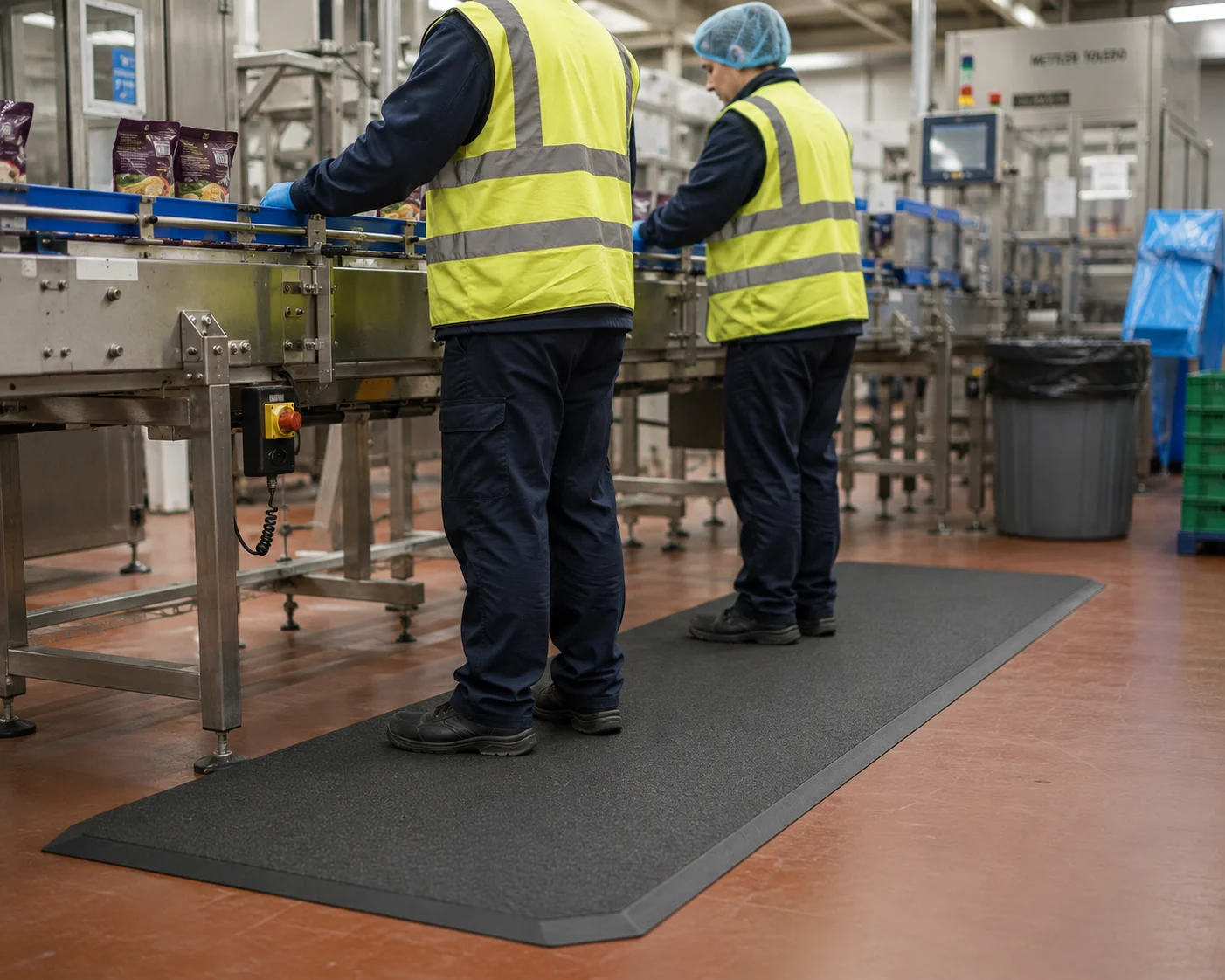
A standard mat is one fixed shape. The M-Lock tile system is whatever you build. 91 × 91 cm interlocking rubber tiles click together to cover any footprint — a single bench or a whole production cell — then finish with safety ramps. Here's how to size it, build it, and pick the right compound.
Dry or wet areas
M-Lock Comfort
Natural-rubber modular tiles for prolonged standing in dry or wet workstations — not for oil.
From £95.00 / tile · View Comfort
Oil & grease
M-Lock Pro
100% nitrile modular tiles that resist oils, greases, and industrial fluids — the same system for dirty floors.
From £175.00 / tile · View Pro
The system
One tile, any floor
M-Lock is a modular anti-fatigue floor built from interlocking rubber tiles. Each tile measures 91 × 91 cm and is 17 mm thick, covering about 0.83 m². Tiles are ESD-compliant (10⁶–10⁹ ohms), made in India, recyclable, REACH compliant, and rated to operate from 10°C to 70°C. Every tile carries a 2-year warranty.
The point of the system is flexibility. Because you build the floor tile by tile, you can match the exact footprint of a bench, a cell, or a walkway — no cutting, no offcuts. As the workspace changes you extend or reconfigure the layout, and if one tile takes damage you replace just that tile instead of a whole mat.
| Tile size | 91 cm × 91 cm |
|---|---|
| Coverage per tile | ≈ 0.83 m² |
| Thickness | 17 mm rubber |
| ESD rating | Compliant: 10⁶–10⁹ ohms |
| Operating temperature | 10°C to 70°C |
| Origin | India; recyclable, REACH compliant |
| Warranty | 2-year (manufacturing defects) |
Pick the compound
Comfort or Pro?
Same modular system, same 91 × 91 cm tile — the only difference is the rubber. The deciding question is simple: is the floor exposed to oil?
M-Lock Comfort
Natural rubber · £95.00 / tile
Suited to dry or wet areas, but not oil exposure. The everyday modular floor.
- Assembly and production cells
- Packing and inspection benches
- Workshops and light engineering
- Retail, trade counters, and warehouse pick faces
M-Lock Pro
100% nitrile rubber · £175.00 / tile
Resists oils, greases, and industrial fluids, with good chemical and moisture resistance.
- CNC, machining, and lathe bays
- Workshops with oil, coolant, or grease
- Engineering and maintenance areas
- Foundries and metalworking cells
Prices shown are recommended retail per tile and pulled live from the current M-Lock catalogue.
Build it
From bare floor to finished mat
Measure the area
Work out the floor area in square metres for the workstation, cell, or walkway you want to cover. The shape can be irregular — you build to fit, so there's no need to force the area into a neat rectangle.
Count your tiles
Divide the area by 0.83 m² per tile and round up. A 10 m² zone needs about 13 tiles. Order a tile or two spare if the layout has tricky corners or you want a replacement on hand.
Prep the floor
The floor must be clean, dry, and free of dust or grease before assembly. A good surface is what lets the tiles sit flat and the glue grip the connector heads.
Click and lock the tiles
Click the interlocking tiles together to build the area, applying a small amount of standard super glue to the connector heads for a secure, permanent assembly. No cutting is required.
Finish the perimeter
Close the open edges with male and female safety ramps — black or high-visibility yellow — to bevel the perimeter down to floor level and cut trip risk. Each ramp is 91 cm long, so divide each exposed edge by 0.91 m to find how many you need.
Coverage maths
How many tiles and ramps?
Tiles
Area ÷ 0.83, rounded up
Each tile covers about 0.83 m². Take your floor area in square metres, divide by 0.83, and round up to the next whole tile.
10 m² ÷ 0.83 ≈ 12.05 → 13 tiles
Ramps
Exposed edge ÷ 0.91 m
Each safety ramp is 91 cm long. Add ramps along the exposed perimeter edges to bevel the run and cut trip risk — divide each open edge by 0.91 m.
From £19.99 / ramp · black or high-vis yellow
Safety ramps
- M-Lock Safety Ramp — Male, Black
- M-Lock Safety Ramp — Female, Black
- M-Lock Safety Ramp — Male, Yellow
- M-Lock Safety Ramp — Female, Yellow
All ramp variants from £19.99 — choose colour and male/female on the product page.
Need help sizing up? Our sizing & coverage guide walks through measuring a workstation. Tiles and ramps are quoted to your floor area — no payment is taken online; a sales rep confirms the order, shipping, and payment.
Modular vs roll
When modular beats a single mat
A standard mat or roll is the simplest answer for one fixed, rectangular workstation. Modular tiles earn their place when the floor isn't that tidy. You can build to any footprint without cutting, extend or reconfigure the area whenever the cell changes, and replace a single damaged tile rather than scrapping a whole mat.
That makes the system a strong fit for irregular layouts, growing production cells, and floors that take heavy localised wear in one spot. For a wider look at how modular tiles stack up against other formats, see our modular matting comparison. If you're weighing fixed comfort mats instead, the M1 vs M2 guide covers the foam-mat ranges, and the full M-Lock line page lists both tiles and every ramp.