Insights
Anti-Slip Matting Regulations UK: What Facilities Managers Need to Know
UK anti-slip matting regulations guide for facilities managers. Covers HSE requirements, BS 7976 testing, PTV ratings and workplace slip resistance compliance.
Buy anti-slip mats online — from £22.95 · in stock · free UK delivery from £75
Shop anti-slip mats
Why Slip Resistance Matters in UK Workplaces
Every year, slips, trips and falls remain the single largest cause of non-fatal workplace injuries in Great Britain. The Health and Safety Executive’s 2024/25 data shows they account for 30% of all RIDDOR-reported injuries. Thousands of workers across manufacturing, logistics and food production are affected.
For facilities managers and health and safety officers, understanding anti slip matting regulations UK employers must follow is essential. This isn’t optional—it’s a legal requirement. This guide covers the regulations, testing standards and practical steps to achieve workplace slip resistance compliance.
The Scale of the Problem: HSE Slip Trip Fall Statistics
The numbers tell a sobering story. In 2024/25, around 680,000 workers sustained injuries at work in Great Britain. HSE slip trip fall incidents on the same level represent the largest single category. They’re ahead of manual handling, being struck by objects and falls from height.
Here’s the breakdown of non-fatal workplace injuries:
| Accident Type | Percentage of Total |
|---|---|
| Slips, trips, falls (same level) | 30% |
| Handling, lifting, carrying | 17% |
| Struck by moving object | 10% |
| Acts of violence | 10% |
| Falls from height | 8% |
| Other causes | 25% |
These incidents cost UK businesses billions each year. The costs come from compensation claims, lost productivity, higher insurance premiums and damaged reputation. More importantly, they cause real harm: broken bones, head injuries and long-term mobility issues.
UK Legislation Governing Workplace Flooring
Three pieces of legislation govern employer duties around slip and trip prevention.
Health and Safety at Work Act 1974
This foundational law requires employers to protect employees and others affected by their work. The duty extends “so far as is reasonably practicable.” This phrase means balancing risk levels against the cost, time or effort of control measures.
Where slip and trip risks exist, employers must act. Failure can result in prosecution, unlimited fines and potential imprisonment.
Management of Health and Safety at Work Regulations 1999
These regulations make risk assessment mandatory. Employers must assess slip and trip risks and take action where needed. This includes finding hazards, deciding who might be harmed, and putting controls in place.
The regulations also require employers to appoint competent persons, provide training and establish emergency procedures.
Workplace (Health, Safety and Welfare) Regulations 1992
Regulation 12 addresses floor conditions directly. Floors must be:
- Suitable for the intended use
- In good condition
- Free from obstructions
- Safe for movement
Where floors may become contaminated with water, oil or debris, people must still walk safely. This is where proper anti-slip matting becomes critical for workplace slip resistance.
Understanding Slip Resistance Testing Standards
Specifying compliant flooring requires knowing how slip resistance is measured. Several testing standards apply in the UK.
BS 7976 and the Pendulum Test
The pendulum test (BS 7976, now largely replaced by BS EN 16165) is the HSE’s preferred method. It uses a swinging arm with a rubber slider that mimics a heel striking a floor.
The test produces a Pendulum Test Value (PTV):
| PTV Score | Slip Potential | Risk Level |
|---|---|---|
| 0-24 | High | Slips likely, fix required |
| 25-35 | Moderate | Risk present, controls needed |
| 36+ | Low | Acceptable for most uses |
| 75+ | Very Low | Extremely slip resistant |
The HSE recommends a minimum PTV of 36 for workplace floors, tested wet and dry. Areas with heavy contamination may need higher values.
To convert PTV to Coefficient of Friction: divide by 100. A PTV of 36 equals a CoF of 0.36.
BS EN 16165: The Current European Standard
BS EN 16165 has replaced BS 7976 as the harmonised European standard. It covers four test methods:
- Pendulum test (Method A)
- Tribometer test (Method B)
- Inclined plane with oil (Method C, replacing DIN 51130)
- Inclined plane with water (Method D, replacing DIN 51097)
This standard is referenced by EN 14411 (ceramic tiles) and EN 13845 (resilient floor coverings).
EN 13845: Safety Flooring Specification
EN 13845 covers PVC floor coverings with enhanced slip resistance. For a floor to be a true “safety floor,” it must meet this standard.
The key is durability. EN 13845 includes abrasion testing to ensure slip resistance lasts. Many vinyl or LVT products achieve R10 or PTV 36+ when new but lose grip under heavy traffic.
For high-risk areas, look for EN 13845 class Esf (enhanced slip, forward) or Esb (enhanced slip, barefoot).
R Ratings: The German Ramp Test
The R rating system comes from German standard DIN 51130 (now in BS EN 16165). A test subject walks on an oil-coated ramp as it tilts until they slip.
The slip angle determines the R rating:
| R Rating | Angle | Typical Use |
|---|---|---|
| R9 | 3° to 10° | Dry areas only |
| R10 | 10° to 19° | Light wet areas |
| R11 | 19° to 27° | General wet areas, kitchens |
| R12 | 27° to 35° | Heavy wet areas, food production |
| R13 | 35°+ | Very heavy wet and contaminated areas |
For industrial settings with regular contamination, R11 is typically the minimum. Food production, commercial kitchens and oily areas often need R12 or R13.
HSE Guidance: The Hierarchy of Controls
The HSE advocates a control hierarchy for slip and trip risks, from most to least effective:
1. Prevent Contamination Reaching the Floor
The best control is stopping contaminants from reaching walking surfaces. A clean, dry floor rarely poses a slip risk.
Consider:
- Reviewing work activities for contamination sources
- Designing out problems (canopies over entrances, fixing leaking machinery)
- Process changes to contain spillages at source
- Enclosing operations that create liquids or debris
2. Control Contamination
Where prevention isn’t possible, containment is next:
- Drip trays under machinery and racking
- Barrier matting at entrances and transition zones
- Good drainage in wet process areas
- Effective, timely cleaning
- A “see it, sort it” workplace culture
3. Eliminate Adverse Conditions
Environmental factors affect floors and behaviour:
- Good lighting so hazards are visible
- Managing condensation in temperature-controlled areas
- Controlling humidity to help floors dry
- Treating ice in winter or near cold stores
- Preventing rainwater ingress through building maintenance
4. Improve Floor Conditions
When other measures fall short, address the floor itself:
- Enhanced cleaning systems
- Surface treatments (etching, shot-blasting) for roughness
- Installing anti-slip matting in high-risk zones
- Full floor replacement when needed
5. Appropriate Footwear
As a final defence, slip-resistant footwear can cut risk significantly. The HSE provides guidance on specifying footwear for different environments.
Where Anti-Slip Matting Fits In
Industrial matting serves multiple functions in this control hierarchy. Understanding anti slip matting regulations UK workplaces must meet helps you choose the right products.
Entrance and Transition Zones
Barrier matting at entrances removes moisture and debris from footwear. Effective systems typically need 3-5 metres of mat coverage to clean shoes properly.
For industrial sites, heavy-duty scraper mats with absorbent secondary matting work best. Clean and maintain these regularly.
Wet Process Areas
In manufacturing with regular water, coolant or oil contamination, drainage matting provides a raised, slip-resistant surface. Fluids drain beneath, preventing pooling and reducing slip risk.
Standing Workstations
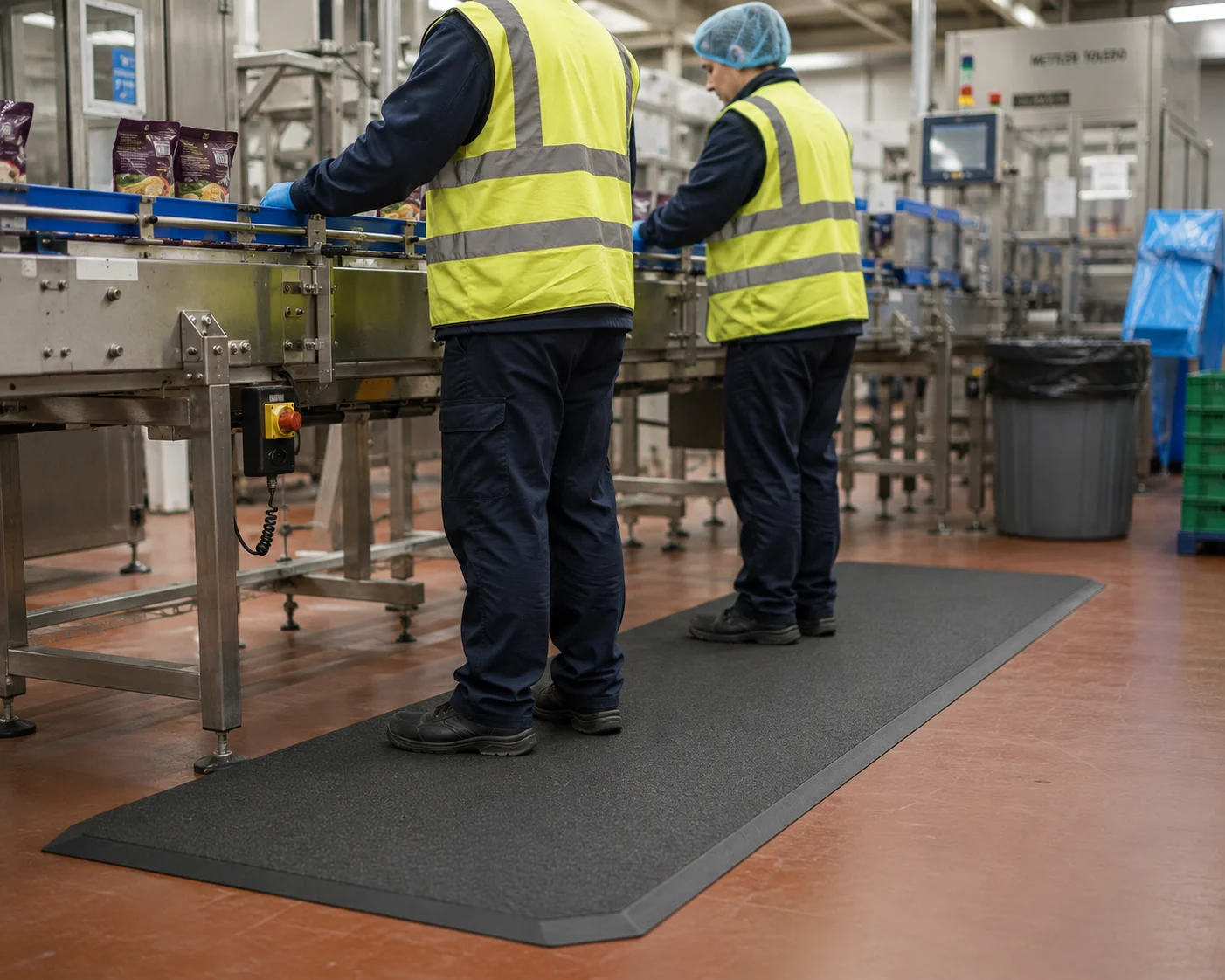
Anti-fatigue matting at assembly lines and machine stations serves two purposes. Beyond reducing fatigue-related strain, quality anti-fatigue mats have textured surfaces that improve workplace slip resistance compared to bare concrete.
Specialised Applications
Different hazards need specific matting:
- ESD matting for electronics, meeting IEC 61340
- Fire-resistant matting for welding bays, conforming to EN 13501-1
- Antimicrobial matting for food and pharmaceutical facilities
- Chemical-resistant matting for labs and chemical processing
Conducting a Slip Risk Assessment
A compliant slip risk assessment follows the HSE’s method:
Step 1: Identify Hazards
Walk your workplace and note:
- Areas where floors get wet or contaminated
- Transition zones between floor types
- Slopes, ramps and level changes
- Areas with poor lighting
- Locations where workers carry loads or rush
- Outdoor areas and entrances
Step 2: Determine Who Might Be Harmed
Consider:
- Employees in various roles
- Contractors and visitors
- Vulnerable people (those with mobility issues, new workers)
- Night shift workers or those working alone
Step 3: Evaluate Risks and Controls
For each hazard:
- How likely is a slip or trip?
- What would the consequences be?
- What controls exist already?
- Are more measures needed?
Step 4: Record Your Findings
Document:
- Hazards found
- Who is at risk
- Controls in place
- Actions needed and who is responsible
- Target dates
Step 5: Review and Update
Review assessments:
- After major workplace changes
- After any slip or trip incident
- At regular intervals (annually minimum)
Specifying Anti-Slip Flooring and Matting
When choosing anti-slip solutions, facilities managers should consider:
Test Certification
Request certificates showing:
- PTV values (wet and dry)
- R rating where relevant
- EN 13845 compliance for safety flooring
- Testing to BS EN 16165 or BS 7976
Be wary of suppliers who can’t provide independent test data or have outdated certificates.
Durability and Maintenance
A floor that’s slip-resistant when new but degrades fast offers false security. Consider:
- Wear resistance under expected traffic
- How slip resistance is maintained (embedded particles vs surface treatment)
- Cleaning needs and compatibility
- Replacement intervals and whole-life cost
Application-Specific Needs
Match the product to your environment:
- Temperature range (cold stores, hot process areas)
- Chemical exposure
- Load-bearing needs (forklift traffic, heavy equipment)
- Hygiene needs (antimicrobial properties, easy cleaning)
- Aesthetic requirements (where applicable)
UK Manufacturing and Recycled Content
UK-manufactured products from recycled materials offer benefits:
- Shorter lead times
- Lower transport emissions
- Support for circular economy
- Often better value
M5 matting systems are made in the UK from 100% recycled PVC. They provide industrial-grade slip resistance with strong environmental credentials. For facilities managers navigating regulatory changes affecting UK SMEs, sourcing locally also reduces supply chain risk.
Common Compliance Mistakes to Avoid
Facilities managers should watch for these frequent errors:
Relying on Manufacturer Claims Alone
“Slip-resistant” is a marketing term with no standard definition. Always request specific test data and compare against HSE thresholds.
Testing in Dry Conditions Only
A floor that performs well dry may be dangerous when wet. Ensure products are tested in realistic conditions.
Neglecting Maintenance
Even the best anti-slip surface fails if covered in oil, debris or worn smooth. Follow maintenance schedules.
One-Size-Fits-All Solutions
Different facility areas have different risk profiles. Zone your workplace and specify solutions for each area.
Forgetting Transitional Areas
Junctions between floor types often create trip hazards. Use proper edge strips and gradual transitions with consistent slip resistance.
Building the Business Case
Beyond compliance, proper anti-slip solutions deliver measurable returns:
Direct Cost Savings
- Fewer workers’ compensation claims
- Lower insurance premiums
- Avoided legal costs and HSE penalties
- Less temporary labour to cover injured workers
Productivity Benefits
- Less time lost to accidents and investigations
- Improved worker confidence and morale
- Reduced presenteeism (workers afraid to move freely)
- Better reputation with potential employees
Regulatory Protection
Showing compliance through documented assessments, certified products and good records provides protection. It proves you’ve discharged your duty of care.
Next Steps for Facilities Managers
To meet anti slip matting regulations UK employers must follow:
- Audit current conditions: Walk your facility and identify slip and trip hazards
- Review documentation: Check that risk assessments are current and controls are in place
- Test high-risk areas: Consider independent slip testing of critical zones
- Develop a specification: Create clear requirements referencing appropriate standards
- Source certified products: Work with suppliers who provide full test documentation
- Establish maintenance schedules: Keep anti-slip properties maintained throughout product life
- Train your workforce: Everyone should understand their role in preventing slips and trips
Conclusion
Anti-slip matting and flooring aren’t optional extras for UK workplaces. They’re fundamental parts of a legally compliant safety system. With HSE slip trip fall incidents causing nearly a third of workplace injuries, the cost of inaction is both human and financial.
By understanding the regulations, specifying products to proper standards and maintaining rigorous slip risk management, facilities managers can protect their workforce and their organisation. As regulatory requirements continue to evolve, staying informed is essential.
For guidance on selecting the right anti-slip matting for your facility, contact the Maximum Matting team. Our UK-manufactured M5 systems are tested to the standards in this guide and designed for the demands of British industry.